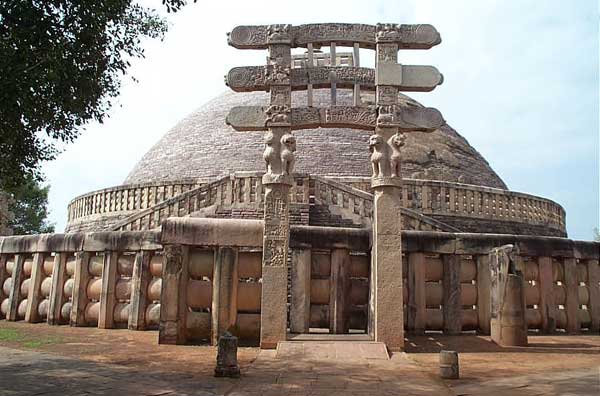
What Sanchi Stupa means
Sanchi Stupa matters because it gives Buddhist memory a public body. Some places are remembered for an event in the Buddha's life. Sanchi Stupa is remembered for the way a tradition made itself visible afterward. That difference is important. The site is less about one sacred instant and more about continuity in public form.
This makes the site especially useful for readers who want to understand Buddhism as a lived civilization and not only as doctrine. At Sanchi, memory is carried in stupas, gateways, carved surfaces, and the relation between built form and reverence. That combination gives the place unusual clarity. You can see how a tradition learned to speak in architecture without having to reduce itself to architecture.
Sanchi is in Madhya Pradesh and is commonly approached through Bhopal and Vidisha. Its location places it outside the main Bihar-centered life-sites, which is part of why it matters. Sanchi widens the map. It shows that Buddhist presence in India was geographically broader and culturally richer than a narrow sacred itinerary can suggest.
The site also feels distinct because it is so clearly architectural. Visitors often understand immediately that Sanchi Stupa is not only about something that happened there. It is about how Buddhism was remembered, expressed, and stabilized in the public world. That gives it a different kind of authority from the life-sites of the Buddha. It teaches through continuity rather than through one remembered episode.
The Great Stupa and the gateways
The Great Stupa is the strongest visual center of Sanchi, but its meaning comes from more than size alone. The form, the gateways, and the carved surfaces all help create a public language of Buddhist memory. A visitor can see that the site was meant to be approached, circled, read, and inhabited with attention.
This is one reason Sanchi Stupa stays with people. It shows that Buddhist memory was shaped deliberately in public space. The site does not merely survive by accident. It demonstrates care, design, and a wish to make moral memory durable. The gateways matter especially because they turn the approach into an act of reading. They ask a visitor not only to look, but to understand how image, movement, and reverence were once held together.
Sanchi also helps a reader imagine the long public life of Buddhism after the Buddha. It is not a private relic. It is evidence that Buddhism learned how to stand in the open, how to accept patronage, how to create forms that a wider community could gather around, and how to transmit memory through shape and symbol. That larger historical meaning makes the site feel fuller than a simple monument description can capture.
Sanchi becomes especially meaningful when it is read as public memory rather than only as heritage. The site says that a tradition can leave marks on the world that outlast any one generation. It can become visible in structure, art, and the organization of space. That is what makes Sanchi Stupa so important. It is not only preserving history. It is preserving the public fact of Buddhism.
For many readers, this changes how the whole Buddhist story looks. Buddhism stops appearing as only a set of teachings floating above the ground. It becomes something that once shaped architecture, patronage, and civic presence.
Why this place is important for Ambedkarites
Sanchi matters for Ambedkarites because Ambedkar's return to Buddhism was not a move into emptiness. It was a return to a tradition with deep roots, public memory, and visible civilizational achievements. Sanchi Stupa helps make that visible. It strengthens the sense that Buddhism in India once occupied public space with confidence and dignity.
This also matters because Ambedkarite public life itself values visible symbols, memorials, and places of collective meaning. Sites such as Deekshabhoomi and Chaityabhoomi are modern examples of that instinct. Sanchi shows that public Buddhist form has older roots in the subcontinent.
Sanchi is a useful place for thinking about why public symbols matter. A moral tradition does not live only in books or private intention. It also lives in what people build, preserve, and return to together. That is one of the lessons Sanchi teaches clearly. Symbols are not decoration. They are part of how collective memory remains active.
For Ambedkarite readers, that lesson can be especially sharp. It helps explain why places of memory and visible public dignity matter so much in modern Ambedkarite life.
It also keeps one larger fact in view. Ambedkar's turn to Buddhism did not create Buddhist dignity out of nothing. It reopened a relation to an older civilizational history that had already left deep marks on the land. Sanchi Stupa helps make that continuity visible. For that reason alone, it belongs in any serious Ambedkarite reading of Buddhist India.
How to reach
Sanchi is relatively easy to reach from Bhopal and Vidisha. Because the site is well known and often visited as both a Buddhist and heritage destination, the travel planning is simpler than for some quieter places. The numbers below are approximate and meant only as a basic guide.
| Starting point | Approx. distance | Approx. time | Approx. taxi fare |
|---|---|---|---|
| Bhopal side | 46-50 km | 50-70 min | Rs. 900-1,300 |
| Bhopal Airport route | 50-55 km | 1-1.25 hr | Rs. 1,100-1,400 |
| Vidisha | 10-12 km | 20-25 min | Rs. 200-350 |
Because Sanchi is compact and legible, it often works well for day visitors, but it rewards anyone who gives it enough time to be read rather than only photographed.
Visiting Sanchi today
Visiting Sanchi today means moving between two kinds of attention. One is historical and architectural. The other is moral and Buddhist. The site supports both without forcing the visitor to choose too quickly between them. That balance is part of its strength. Sanchi can be entered through beauty, through heritage, through Buddhism, or through a concern with public memory.
For Ambedkarite visitors, the site often deepens the sense that Buddhism in India once left strong public marks on the world, and that modern Buddhist return does not have to begin from weakness or cultural absence.
At Sanchi, visitors often notice order, form, and public readability. The site teaches by visibility. It lets people see how a tradition can become inhabitable in architecture. That is a different kind of lesson from the one offered by Bodh Gaya or Shravasti, and it gives Sanchi its own voice.
For many people, that voice is what makes the site memorable. Sanchi does not feel hidden. It feels composed.
That composure is part of the experience. The site does not ask for dramatic reaction. It works more slowly. People notice how the pathways, railings, domes, and gateways organize attention. The result is not only admiration for old skill. It is a clearer sense that Buddhist public life once had structure, confidence, and a durable visual language. That is often what visitors carry away from Sanchi Stupa more than any single detail.
Sanchi in an Ambedkarite reading
Sanchi becomes stronger in an Ambedkarite reading when it is treated as evidence of Buddhism's public historical presence in India. It does not speak directly to Babasaheb's life the way Rajgruha or Deekshabhoomi do. Instead, it speaks to the larger civilizational world to which Ambedkar returned. That larger world matters because it shows Buddhism as something historically rooted, not invented for modern need.
That makes Sanchi more than a heritage page. It becomes part of the argument that Buddhism in India had dignity, scale, and public shape long before the modern period.
Related places
From Sanchi Stupa, continue to Ajanta Caves and Ellora Caves to follow Buddhist visual and architectural memory further, or return to the full places hub.
Conclusion
Sanchi Stupa matters because it lets Buddhism be seen in public form. It keeps memory, reverence, and architecture together. For Ambedkarite readers, that is especially meaningful because it restores a sense of Buddhism as a visible and durable part of Indian history. Sanchi Stupa remains one of the clearest places where that fact can still be felt.