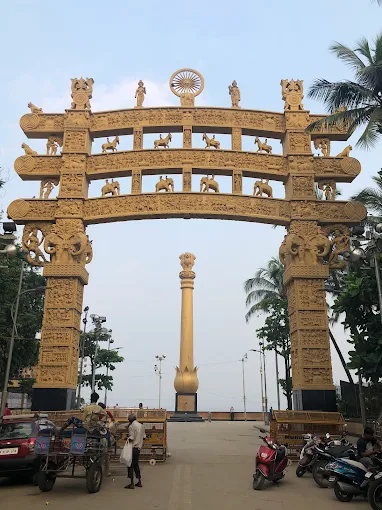
Meaning of Chaityabhoomi
The name Chaityabhoomi carries a sense of reverence from the beginning. “Chaitya” points toward a memorial or sacred Buddhist structure, while “bhoomi” means ground or place. In the case of Chaityabhoomi, the name matters because the site is not approached as an ordinary memorial ground. It is read by Ambedkarites as a place where remembrance takes public form with unusual seriousness.
That meaning also helps explain why the site feels different from a civic monument. People do not go there only to look back at a leader in formal respect. They go there because Babasaheb continues to shape the moral and political life of the present. The place therefore holds not only the memory of a great individual, but the ongoing continuity of a people who still gather under his name.
Location and overview
Chaityabhoomi is located in Dadar West, Mumbai, close to the seafront and within one of the city's most widely recognized public zones. Its location matters because Mumbai was deeply tied to Ambedkar's life, study, writing, legal work, and political struggle. The city was not a background setting for his work. It was one of the places where he read, argued, organized, and shaped public life.
Because of that, Chaityabhoomi is not simply a place within Mumbai. It is one of the places through which Mumbai itself is read in Ambedkarite memory. People who visit often understand it in relation to other Mumbai sites such as Rajgruha, where Ambedkar lived and worked, and in relation to larger public days such as 14 April Ambedkar Jayanti and Mahaparinirvan Diwas.
The Mumbai connection matters for another reason as well. Babasaheb's public life was not only national in scale; it was also lived through specific cities, institutions, homes, and meeting spaces. Mumbai was one of the cities where his intellectual and political life became especially visible. Chaityabhoomi therefore carries the weight of final public memory in a city already deeply shaped by his work. That gives the place a different kind of force. It is not only a memorial in Mumbai. It is part of how Mumbai remembers Babasaheb itself.
The historical background of Chaityabhoomi
Chaityabhoomi is most deeply connected with the public remembrance of Dr. B.R. Ambedkar after his death. That is why the site is different in mood from Deekshabhoomi. Deekshabhoomi is strongly marked by a beginning: the conversion to Buddhism on 14 October 1956. Chaityabhoomi is strongly marked by continuation: the place where memory, mourning, loyalty, and public gathering remain active long after Babasaheb's passing.
This difference matters because Ambedkarite public life has always depended on more than documents and ideas alone. It has also depended on places where people could gather, see one another, and keep memory alive across generations. Chaityabhoomi became one of those places because remembrance of Babasaheb was never small or private. It was collective from the beginning, and it remained collective because his work had changed the lives of people who did not experience him as a distant historical figure.
The historical force of Chaityabhoomi also comes from Mumbai itself. Babasaheb's intellectual and political life had deep connections with the city, and that gave public mourning there a particular weight. Chaityabhoomi did not become important only because it was marked as a memorial site on a map. It became important because large numbers of people already understood Mumbai as one of the cities through which Babasaheb's public life had been lived. That made the place feel less like an assigned memorial and more like a natural ground of return.
Over time, that return became a pattern strong enough to shape the site's identity. People did not come once and stop. They kept coming back, year after year, to remember Babasaheb not as a completed chapter of history but as a continuing source of direction. That repeated public act is part of the history of Chaityabhoomi itself. The place became what it is because remembrance there stayed active, organized, and collective across generations.
Mahaparinirvan Diwas at Chaityabhoomi
Chaityabhoomi becomes one of the most important public places in the Ambedkarite calendar during Mahaparinirvan Diwas on 6 December. Large numbers gather there to pay respect to Babasaheb, to remember his life and struggle, and to renew their connection with the values he stood for. The atmosphere on that day is not easy to reduce to one mood. It includes mourning, discipline, pride, seriousness, gratitude, and a sense of public continuity.
That annual gathering is important because it shows that Chaityabhoomi is not only a site of the past. It remains part of a living movement. People do not gather there only because something happened once. They gather because they still understand Ambedkar's work as unfinished and because memory itself is part of how movements continue. For many visitors, the experience of standing in that crowd makes the scale of Ambedkarite public life clearer than any summary could.
The waiting itself matters. People often stand in long lines, move slowly, and make the visit with patience because paying respect at Chaityabhoomi is not treated as a casual gesture. In Ambedkarite public life, that act of waiting has meaning. It says that memory is worth time, effort, and physical presence. It also says that Babasaheb is not remembered only through slogans or annual messages, but through disciplined collective attention. That is one reason the gathering feels so serious even when the numbers are very large.
Why this place is important for Ambedkarites
Chaityabhoomi matters for Ambedkarites because public memory is one of the ways dignity is kept alive. A movement that does not return to its own sites of remembrance can become abstract or scattered. Chaityabhoomi works against that. It gives people a place where the memory of Babasaheb is felt not as distant praise, but as an active relation between past struggle and present responsibility.
The site is also important because Ambedkar is remembered there not in only one role. He is remembered as Babasaheb, the person whose life moved through scholarship, law, anti-caste struggle, constitutional thinking, and the turn to Buddhism. That fuller memory matters. It helps prevent reduction. Chaityabhoomi is therefore not only a place of emotion. It is also a place that asks visitors to remember the scale of Ambedkar's work and the seriousness of what he still demands from public life.
For younger visitors, this can be especially important. A first visit to Chaityabhoomi often makes Ambedkarite identity feel more concrete. A person sees that they are not remembering alone. They are part of a larger public continuity shaped by study, struggle, self-respect, and organized memory. That is one of the reasons the place remains so powerful.
The memorial and physical setting
The physical setting of Chaityabhoomi matters because it gives form to public remembrance without trying to turn memory into spectacle. The memorial space is approached with seriousness, and visitors often notice that the setting works by gathering attention rather than scattering it. That quality is important. A site of remembrance should help people become more inward and more alert to public meaning at the same time.
The location near the sea also shapes the experience of the place. The wider setting of Dadar Chowpatty and Shivaji Park side of the city means that Chaityabhoomi sits inside a busy urban life while still holding a distinct moral space of its own. That contrast is part of its force. It reminds visitors that Ambedkarite memory does not stand outside the modern city. It stands inside public life and asks to be carried within it.
Visiting Chaityabhoomi today
People visit Chaityabhoomi for different reasons, but most visits carry some combination of tribute, reflection, and movement memory. On major remembrance days the site is marked by crowd, waiting, public discipline, book stalls, speeches, and the visible presence of Ambedkarite community life. On quieter days it offers a different experience: less scale, more pause, and more room to reflect on what Ambedkar's life still means in private conscience as well as public action.
That difference matters. A large visit shows Chaityabhoomi as collective memory. A smaller visit shows it as personal and reflective space. Both are valid, and together they help explain why the place remains central. It speaks both to the community and to the individual visitor.
How to reach
Chaityabhoomi can be reached fairly easily from the airport, Dadar station, and the nearby Shivaji Park side of Mumbai. For many visitors, this practical accessibility matters because the site often forms part of a day of study, remembrance, or movement-related travel rather than a separate long-distance journey inside the city.
The table below gives a simple planning view. Distances and fares are approximate and can change with traffic, demand, and service type, but they give a useful starting point.
| Starting point | Approx. distance | Approx. time | Approx. taxi fare |
|---|---|---|---|
| Chhatrapati Shivaji Maharaj International Airport | 10-11 km | 20-35 min | Rs. 180-230 |
| Dadar Railway Station (West side) | 1-3 km | 7-12 min | Rs. 40-120 |
| Shivaji Park / Plaza side | 0.8-1.5 km | 5-10 min | Rs. 40-80 |
The ease of reaching Chaityabhoomi matters because remembrance here is public, not hidden. The place remains open to students, readers, families, organized groups, and first-time visitors who want to understand Ambedkarite memory more directly.
When to visit Chaityabhoomi
The most important time to visit is around 6 December if you want to experience Chaityabhoomi in its fullest public form. That is when the site becomes one of the clearest expressions of Ambedkarite remembrance in India. The scale of gathering can be intense, but it also shows the continuing force of Babasaheb's place in public life.
At the same time, quieter visits outside the biggest gathering days offer a different kind of value. They allow more space for reflection and for understanding the site without the pressure of very large crowds. The best time depends on whether you want to experience the place as mass memory, quiet remembrance, or both.
What a first visit can feel like
A first visit to Chaityabhoomi can feel very different depending on when it happens. On ordinary days, the site gives more room for silence, slower reflection, and a closer sense of place. Around 6 December, the meaning is far more collective. The crowds, waiting, movement, and public discipline become part of the experience itself. Neither kind of visit is more correct. They simply reveal different sides of the same place.
For first-time visitors, the best approach is to come with patience and seriousness. Chaityabhoomi is not a stop to rush through. It helps to arrive with some understanding of Babasaheb's life, and it helps even more to notice how other people are holding the place. Much of Chaityabhoomi's meaning becomes clear not only from the structure itself, but from the way people gather, wait, pay respect, and leave with care.
Entry, timings and guidelines
Visitors should approach Chaityabhoomi with respect, patience, and public discipline. This is not a tourist stop in the ordinary sense. It is a place of remembrance tied to Babasaheb and to a larger community that still experiences the site with emotional seriousness. Cleanliness, order, and attention to the surrounding public space matter.
Timings can change depending on local arrangements and major observance days, so it is best to check before planning a detailed visit. But the deeper guideline remains simple: come with seriousness, not spectacle.
What stays with people at Chaityabhoomi
At Chaityabhoomi, visitors usually experience a distinctive mix of public feeling and inward reflection. The public side includes crowds, processions, reading material, visible tribute, and the sense of standing in a place where many others have come with the same purpose. The inward side includes silence, recollection, and the question of what it means to remember Babasaheb responsibly rather than ceremonially.
This combination gives the place its special character. Chaityabhoomi is not only about looking back. It is also about asking what kind of person, community, and public life Ambedkar's memory still demands. That is why the site remains relevant even to those who have read widely about him already.
Why Chaityabhoomi remains essential
Every Ambedkarite should visit Chaityabhoomi at least once if possible because the place helps turn memory into lived understanding. Reading about Babasaheb matters. Studying his books matters. But a visit to Chaityabhoomi makes one more dimension clear: the scale of collective attachment, grief, discipline, and continuity that his life still commands.
The visit is not important as a ritual duty. It is important because it helps connect thought with public memory. Many people understand Ambedkar's work more fully after they have stood at Chaityabhoomi and seen how deeply his life remains present in the people who continue to gather there.
Related places
After Chaityabhoomi, continue to Deekshabhoomi to understand the place of conversion, or go to Rajgruha to connect public memory with the home and study life of Babasaheb in Mumbai. To widen the reading further, return to the full places hub or continue to Who Was B.R. Ambedkar.
Conclusion
Chaityabhoomi is not only a memorial space in Mumbai. It is one of the clearest places where Ambedkarite public memory remains active, visible, and morally serious. It gathers remembrance, movement continuity, grief, gratitude, and responsibility into one ground. To visit Chaityabhoomi is not just to honor Babasaheb. It is to stand inside a public memory that still shapes the present.