What Ajanta Caves mean
Ajanta Caves matter because they help readers understand that Buddhism was carried through image, architecture, and monastic environment as well as through text. This gives the site a very different feel from the places tied directly to the Buddha's life. Ajanta is not about origin alone. It is about what a tradition became as it settled into cultural and artistic form.
That difference is important. Ajanta shows that Buddhism in India once had a fully developed visual and spatial life. It occupied caves, walls, surfaces, and shared built environments. The site makes Buddhist civilization feel materially present.
It also helps correct a narrow reading of Buddhism as only sermon, doctrine, or inward practice. At Ajanta Caves, the tradition appears as labor, memory, devotion, residence, and visual intelligence all at once. That fuller picture is what gives the site its unusual depth.
Location and overview
Ajanta Caves are in Maharashtra and are usually approached through Jalgaon or Aurangabad. Their location in the Deccan helps widen the Buddhist map beyond the more familiar north Indian life-sites. That widening matters because it shows that Buddhist memory and Buddhist culture spread through multiple regions and did not remain confined to one sacred corridor.
The setting also shapes how the place is felt. Ajanta is not encountered first as a city site or a stupa field. It is encountered as a cave complex, and that gives the visit a more enclosed and layered quality. The site asks the visitor to enter rather than only to look from outside.
The caves, murals, and monastic world
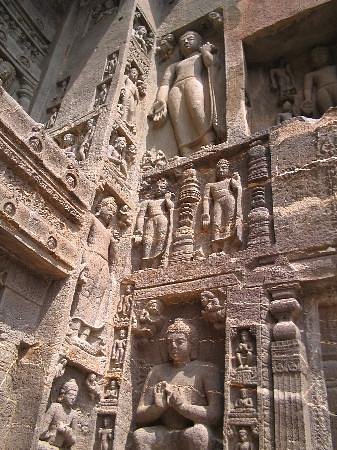
The deepest strength of Ajanta Caves lies in the way caves, murals, and monastic space come together. A visitor is not simply viewing old art. They are entering the remains of a Buddhist environment where visual teaching, devotion, residence, and artistic labor all met. That makes Ajanta unusually rich. It preserves both aesthetic achievement and religious life.
The murals matter because they keep Buddhist imagination visible. The caves matter because they preserve the spatial structure of monastic and devotional life. Together, they turn Ajanta into more than a heritage stop. They turn it into a record of how Buddhism inhabited the world.
That is part of why the site keeps rewarding return. The more carefully one reads Ajanta Caves, the more clearly one sees that Buddhist culture once shaped not only belief, but the environments in which people learned, lived, remembered, and practiced. The caves hold both discipline and beauty without separating them.
How Ajanta Caves differ from the Buddha's life-sites
Ajanta feels different from Lumbini, Bodh Gaya, Sarnath, or Kushinagar because its power does not depend on one direct episode from the Buddha's biography. Its power comes from the later life of Buddhism: what was built, painted, carved, and maintained by Buddhist communities after the earliest sacred memories were already known.
That laterness is one of the site's greatest strengths. It teaches that a tradition is not measured only by how it begins. It is also measured by what kinds of cultural worlds it can create and sustain.
Why this place is important for Ambedkarites
Ajanta Caves matter for Ambedkarites because they expand the sense of Buddhist inheritance. Ambedkarite Buddhism often begins from equality, dignity, and the rejection of caste oppression, as it should. But Ajanta helps show that the tradition Babasaheb returned to also had deep cultural, artistic, and civilizational breadth. That recognition can matter both intellectually and emotionally.
The site also helps resist cultural erasure. Ajanta makes it difficult to tell the story of India honestly while pushing Buddhism to the margins. For Ambedkarite readers, that matters a great deal. It confirms that Buddhism was never a small or decorative strand in Indian history.
Ajanta and the refusal of cultural erasure
One of Ajanta's strongest modern meanings is that it stands against forgetting. The site preserves a scale of Buddhist presence that cannot be dismissed as minor. It says that Buddhist culture in India once shaped visual life, artistic achievement, and monastic space in enduring ways.
For Ambedkarite readers, this matters because recovery of memory is part of justice. To know Ajanta is not only to admire beauty. It is to understand that Buddhist contribution to Indian civilization was large, serious, and structurally important.
That refusal of erasure matters in practical terms too. A place like Ajanta Caves gives younger readers something concrete to stand on. It shows that Buddhist India is not abstract, borrowed, or imagined backward from modern need. It was real, built, disciplined, and culturally confident.
How to reach
Ajanta is usually reached through Jalgaon or Aurangabad. Visitors often decide between the shorter Jalgaon side and the more commonly known Aurangabad route. The figures below are approximate and meant as planning help rather than fixed rates.
| Starting point | Approx. distance | Approx. time | Approx. taxi fare |
|---|---|---|---|
| Jalgaon Airport side | 49-50 km | 47-60 min | Rs. 1,000-1,300 |
| Aurangabad Airport | 83-84 km | 1 hr 20 min | Rs. 1,500-1,900 |
| Ajanta visitor side | 4-8 km | 10-20 min | Rs. 150-300 |
Because the site is experienced through entry into caves and sustained looking, Ajanta rewards visitors who leave themselves enough time to slow down rather than rush through the complex.
Visiting Ajanta today
Visiting Ajanta Caves today means learning how to look carefully. The site does not work well when reduced to quick visual consumption. Its strength lies in accumulated attention: wall by wall, space by space, form by form. That slower pace is part of the meaning because Ajanta preserves a world built through long labor.
For Ambedkarite visitors, that patience can be especially valuable. It allows the site to become more than proof of old greatness. It becomes a place where Buddhist cultural depth can actually be felt.
Many visitors leave with the sense that Ajanta Caves are not only visually impressive, but intellectually steadying. The site gives a different scale to Buddhist history. It reminds the reader that traditions endure not only by preaching truth, but by organizing communities, shaping environments, and sustaining forms of life over time.
What you notice inside the caves
Inside the caves, visitors often notice that Ajanta teaches through atmosphere as much as through information. The relation of light, painted surface, carved form, and enclosed space creates a feeling different from open-air Buddhist sites. Ajanta feels inward, but not private. It feels shaped for contemplation, residence, and visual memory at once.
That combination is what makes the site so singular. Ajanta is not simply a page to be read. It is an environment to be entered.
Ajanta in an Ambedkarite reading
Ajanta Caves become especially meaningful in an Ambedkarite reading when they are taken as part of the larger recovery of Buddhist history in India. They do not link directly to Babasaheb's biography in the way Rajgruha or Deekshabhoomi do. Instead, they strengthen the sense of what Buddhism in India once was: intellectually serious, artistically capable, and culturally large.
That matters because Ambedkar's return to Buddhism was not a step into a narrow moral refuge. It was a return to a tradition with deep civilizational resources. Ajanta helps make that larger fact visible.
Related places
From Ajanta Caves, continue to Ellora Caves for another major cave complex, or to Sanchi Stupa for Buddhism's public architectural memory in stone. You can also return to the full places hub.
Conclusion
Ajanta Caves matter because they keep Buddhist memory alive through painting, stone, and monastic space. They widen the idea of what Buddhist history in India looks like. For Ambedkarite readers, that widening is especially important. It helps restore the scale, depth, and dignity of a tradition too often reduced or forgotten.