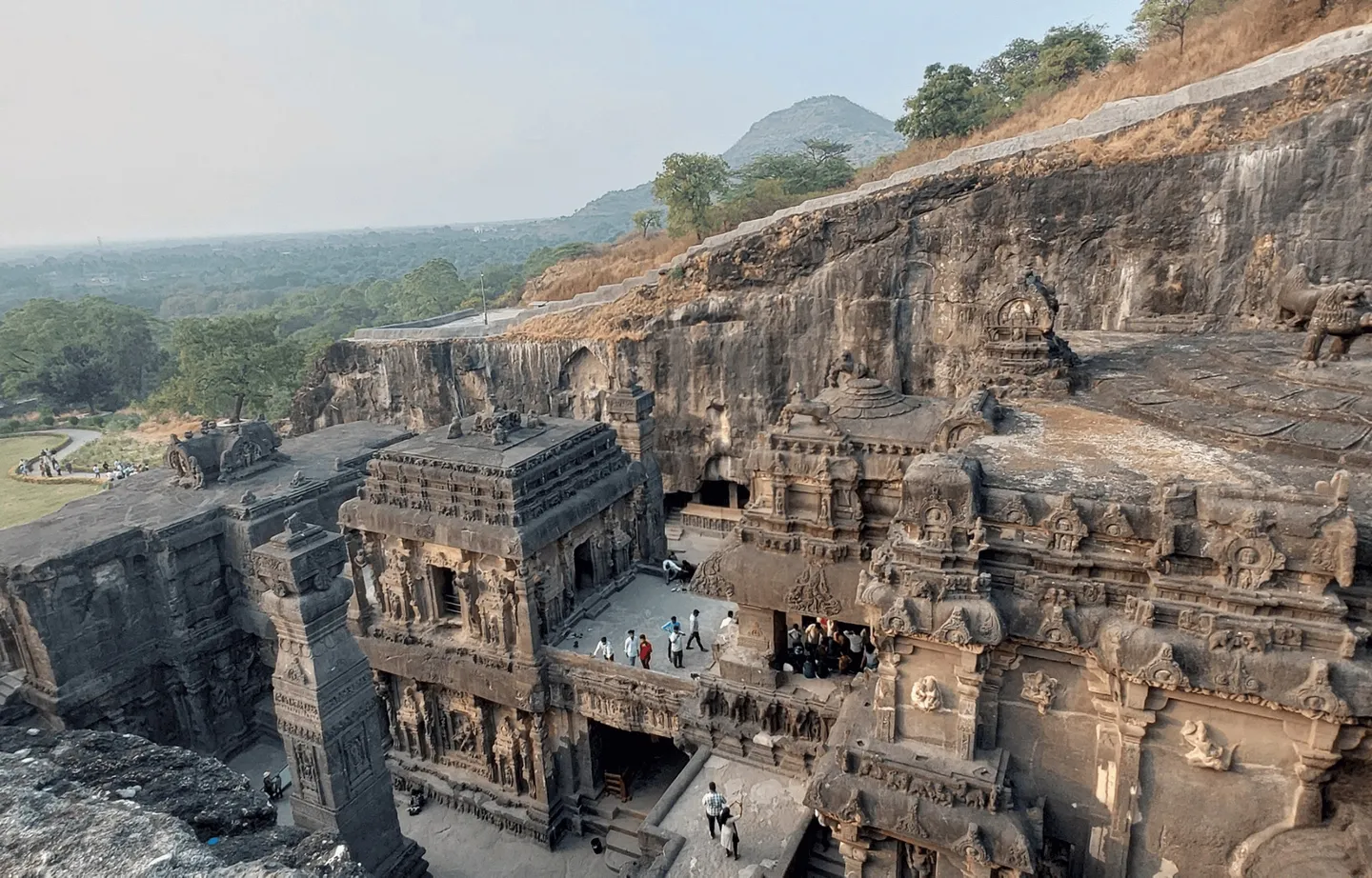
What Ellora Caves mean
Ellora Caves matter because they preserve Buddhist heritage in a setting that does not isolate it from the rest of history. That gives the site a special kind of seriousness. A visitor is not asked to imagine Buddhism in abstraction. They are asked to notice how Buddhist spaces stood within a broader world and still carried a distinct ethical and visual presence.
This helps widen the way Buddhist history is read. Some sites are remembered through one sacred event. Ellora is remembered through historical coexistence, architectural endurance, and the way Buddhist material culture remains legible inside a larger carved landscape. That layered quality is what gives the place its intellectual weight.
It also makes the page important on this site. Ellora helps readers who do not want a simplified or devotional-only version of history. It keeps Buddhist heritage visible while also asking for historical attention and seriousness.
Location and overview
Ellora Caves are in Maharashtra and are commonly reached through Chhatrapati Sambhajinagar, formerly Aurangabad. Their location in the Deccan widens the Buddhist map beyond the life-sites more often associated with Bihar and Uttar Pradesh. That widening matters because it shows how Buddhist presence moved through regions, landscapes, and architectural traditions across India.
The site feels different from Ajanta as soon as a visitor begins to orient themselves. Ellora is not mainly remembered for painted interiors or an inward visual atmosphere. It is remembered through carved scale, spatial breadth, and the way Buddhist caves stand inside a wider and more visibly layered setting.
The Buddhist caves within the larger site
The Buddhist caves at Ellora matter because they preserve monastic and devotional spaces with strong material clarity. They show Buddhism not only as thought, but as an inhabited and organized way of life. A visitor can still sense the relation between carved form, spatial use, and the discipline of a religious community.
What makes Ellora especially interesting is that the Buddhist caves do not need to stand alone in order to stand clearly. Their presence remains distinct even inside the larger site. That distinctness matters because it demonstrates that Buddhist history in India was materially serious, architecturally capable, and publicly real.
This is also where Ellora becomes especially useful for study. It asks readers to hold two truths together at once: the integrity of Buddhist heritage, and the complexity of the wider world in which that heritage lived. That is a more demanding lesson than a simpler pilgrimage narrative, but it is often a more durable one.
How Ellora Caves change the way history is read
Ellora Caves encourage a broader reading of history. They show that Buddhist heritage in India did not move through one untouched sacred channel. It existed within changing worlds shaped by patronage, proximity, and historical transition. This is not a weakness of the site. It is one of its greatest strengths, because it allows history to remain honest without making Buddhism disappear inside that honesty.
For many readers, Ellora changes the scale of what Buddhist history feels like. It stops being only textual or only biographical. It becomes architectural, regional, and materially rooted. That is why the site often feels more historically instructive than a quick visit might suggest.
Why this place is important for Ambedkarites
Ellora Caves matter for Ambedkarites because Ambedkarite reading often asks for a combination of confidence and critique. Confidence matters because Buddhism in India had real depth, scale, and public presence. Critique matters because history must be read carefully, without sentimentality or simplification. Ellora supports both.
This is important because Ambedkar did not return to Buddhism in ignorance of history. He returned through study, judgment, and moral seriousness. A place like Ellora honors that method better than a softer heritage reading would. It allows Buddhist presence to be felt strongly, while still keeping historical complexity visible.
Ellora can therefore deepen Ambedkarite confidence without encouraging mythic excess. It says that Buddhist civilization in India was substantial, but it also says that historical truth is rarely neat. That balance is healthy for a movement grounded in study, reason, and moral clarity.
It also helps answer a deeper question. If modern Ambedkarite Buddhism is a return, what exactly is it returning to? Ellora helps answer that by showing that Buddhism in India once existed not only as doctrine, but as carved space, organized life, public presence, and durable memory.
How to reach
Ellora Caves are commonly reached through Chhatrapati Sambhajinagar and nearby transport points. Because the site is well known, planning is straightforward, but the experience itself rewards more time than people sometimes expect. The figures below are approximate and meant as a practical guide.
| Starting point | Approx. distance | Approx. time | Approx. taxi fare |
|---|---|---|---|
| Chhatrapati Sambhajinagar city side | 28-32 km | 40-55 min | Rs. 700-1,100 |
| Airport route | 35-38 km | 50-65 min | Rs. 900-1,300 |
| Daulatabad side | 13-16 km | 20-30 min | Rs. 250-450 |
Because Ellora is read through both scale and detail, it helps to leave enough time for the Buddhist caves specifically rather than letting the larger site blur everything together.
Visiting Ellora Caves today
Visiting Ellora Caves today means learning how to distinguish without separating too sharply. The larger site is broad, but the Buddhist caves still ask for focused attention. The visit becomes more meaningful when people pause to ask what makes these caves specifically Buddhist in mood, use, and historical significance.
For Ambedkarite visitors, Ellora can be read alongside Ajanta Caves and Sanchi Stupa as part of a wider return to Buddhist presence in Indian history. Together, these places help counter the idea that Buddhism in India survives only as text or distant memory. They show instead that Buddhist material culture once stood strongly in public life.
Many visitors leave Ellora with a more demanding understanding of heritage. The site does not flatter the viewer with a simple story. It gives something better: a clearer sense that Buddhist history was real, layered, and strong enough to remain legible even inside a complex civilizational setting.
Related places
From Ellora Caves, continue to Ajanta Caves for another major cave complex, or read Sanchi Stupa to see Buddhist heritage through stupas and architectural commemoration. The full places hub connects them all.
Conclusion
Ellora Caves matter because they let Buddhist heritage be seen inside history rather than outside it. They preserve Buddhist material presence clearly, while also keeping the larger historical world in view. For Ambedkarite readers, that combination is especially valuable. It restores both confidence and seriousness, which is exactly the kind of reading a place like Ellora deserves.