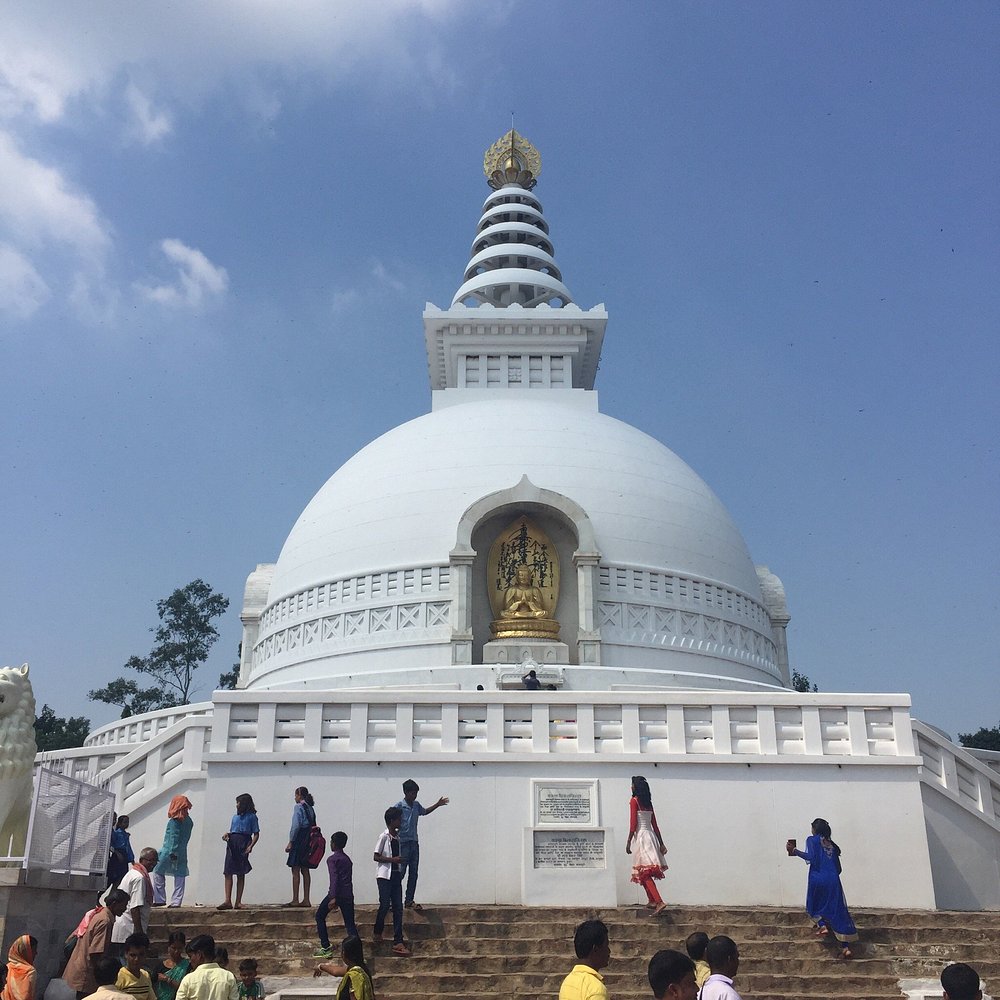
Why Rajgir matters
Rajgir matters because it widens the map of Buddhist memory. Some places are tied to one decisive moment: awakening, first teaching, birth, or mahaparinirvana. Rajgir is different. It holds a whole environment in which Buddhism was taught, discussed, housed, and lived. That gives the place a broader historical texture. A visitor does not come only to remember one dramatic turn. They come to understand the setting in which an ethical and intellectual tradition took shape.
This difference is important. Rajgir keeps the early Buddhist world attached to political power, city life, geography, monastic presence, and the practical movement of people through a real region. It helps readers see that Buddhism grew within human arrangements and not outside them. That simple fact gives Rajgir much of its force.
Rajgir is in present-day Bihar, in the larger Nalanda region, and is often read together with Nalanda and Bodh Gaya. Its location matters because this part of Bihar preserves one of the densest clusters of Buddhist historical memory in South Asia. Rajgir belongs to that cluster, but it has a tone of its own. It feels older, hill-bound, and more connected to the early political and social world of Magadha.
That regional setting matters for visitors because Rajgir is easiest to understand when it is not treated as an isolated stop. The place gains force when it is read as part of the old Buddhist geography of Bihar, where teaching life, institutional life, and pilgrimage memory overlap.
Rajgir was an important city in the age of the Buddha and is tied to the older world of Magadha, one of the major centers of power in ancient India. That background matters because Buddhism did not develop only in forests and retreats. It also developed in conversation with kings, towns, patronage, roads, assemblies, and organized communities. Rajgir helps preserve that fuller context.
When people read Rajgir carefully, they often begin to understand that Buddhism was never only a private inward path. It was also a public moral tradition that had to speak within real social conditions. Rajgir keeps that fact visible. It shows that the Buddha's teaching life was connected with places where power and community already existed, and where a moral path had to make its place inside the world as it was.
Vulture Peak and the teaching landscape
One of the strongest associations in Rajgir is Vulture Peak, or Griddhakuta. Even when visitors do not approach the site as specialists, they often feel that this part of the Rajgir landscape carries a closer relation to teaching than many other places do. That matters because Rajgir is remembered not only as a city but as a setting where the Buddha's presence was tied to repeated instruction, meeting, and return.
Vulture Peak also helps explain why Rajgir feels less like a monument and more like a spread of connected places. The memory of Buddhism here is attached to terrain. Hills, routes, and vantage points matter. That gives Rajgir a bodily quality. A person begins to feel that teaching took place not in abstraction but in a specific physical world.
That is one reason Rajgir stays distinct from the more single-point sacred sites. It teaches through landscape and relation. The place lets visitors feel how Buddhist memory can remain spread across a region without losing clarity. That wider feeling is part of what makes Rajgir rewarding.
Rajgir for Ambedkarites and readers
Rajgir matters for Ambedkarites because Ambedkarite Buddhism is deeply concerned with the relation between moral life and social life. Ambedkar did not read the Buddha as a remote mystic detached from human institutions. He read him as a thinker and teacher whose path had consequences for how people live together. Rajgir supports that reading because it keeps early Buddhism inside a real public world.
The Ambedkarite connection here is not mainly about one direct biographical link to Babasaheb. It is about what Rajgir helps make visible. The place reminds readers that Buddhism developed in relation to power, debate, association, and organized life. That matters because Ambedkarite Buddhism also asks how Dhamma enters society, how it changes conduct, and how it helps create a more just moral order.
Rajgir also belongs naturally beside Nalanda. Together the two places say something important: Buddhism in India was not only born and preached. It was also studied, argued, and sustained through institutions. That line from Rajgir to Nalanda is especially meaningful for Ambedkarite readers because it joins public ethics with disciplined learning.
Rajgir remains compelling because it gives more than one kind of access to Buddhist history. A visitor can approach it through early texts, through the geography of the Buddha's life, through Magadha, through Vulture Peak, or through the surrounding cluster of Bihar's Buddhist places. The site allows all of those entrances without reducing itself to only one of them.
That makes Rajgir valuable for return visits and repeat reading. The place often becomes clearer the more a person knows. It is not only emotionally strong; it is intellectually rewarding. That is one reason it suits the Ambedkarite reading habit of study, connection, and widening context.
Visiting Rajgir today
Rajgir is usually reached through Bihar's larger Buddhist circuit, especially from Gaya, Nalanda, or Patna. Visitors planning a short trip often want a practical sense of the route rather than a long transport breakdown. The figures below are approximate and are best read as planning guidance, since fares can shift with traffic, season, and service type.
| Starting point | Approx. distance | Approx. time | Approx. taxi fare |
|---|---|---|---|
| Gaya side | 61 km | 55-65 min | Rs. 800-1,000 |
| Patna side | 95-100 km | 2-2.5 hr | Rs. 2,500-3,200 |
| Rajgir Railway Station | 2-4 km | 8-15 min | Rs. 80-150 |
Many visitors pair Rajgir with Nalanda on the same journey, and that combination usually makes the trip feel fuller and more intelligible than seeing either place alone.
Rajgir is best approached with time and attention. It is not a place that gives everything at first glance. The visitor often needs to slow down, notice the wider terrain, and let the idea of Rajgir as a teaching landscape settle in. That slower pace is part of the reward. Rajgir becomes stronger when a person lets it widen their sense of Buddhist history rather than rushes to extract one memory from it.
Respect matters here as at other Buddhist places. Silence, patience, and a willingness to look beyond only the most photographed point help the site open up. Rajgir is one of those places that becomes better the less hurriedly it is consumed.
Visitors often experience Rajgir as a place of spread rather than concentration. The power of the site comes from relation: hill to city, city to teaching place, region to region, Rajgir to Nalanda, older Magadha to later Buddhist memory. That relational quality is what makes Rajgir feel alive. A person begins to understand Buddhism not as a chain of separate holy points, but as a living network.
For Ambedkarite visitors, that can be especially useful. The place helps resist shallow or sentimental readings of Buddhism by restoring social setting, political world, and intellectual seriousness. Rajgir says that Dhamma moved through history, not outside it.
Rajgir becomes especially meaningful in an Ambedkarite reading when it is treated as one of the places that helps explain Buddhism as a social and rational tradition. It does not replace Ambedkarite movement sites such as Deekshabhoomi, Chaityabhoomi, or Mahad. Instead, it gives older historical depth to the path that Ambedkar publicly chose.
That is the real value of Rajgir here. It does not ask for decorative reverence. It asks for historical seriousness. It helps make the older Buddhist world more concrete, which in turn helps make Ambedkar's return to Buddhism more fully intelligible.
Related places
From Rajgir, continue to Nalanda to follow Buddhism into organized learning, or return to Bodh Gaya to reconnect this wider landscape to awakening itself. You can also go back to the full places hub whenever you want the larger map.
Rajgir is one of the places where Buddhism looks fully historical without becoming less meaningful. It keeps together teaching, terrain, city life, and the older world of Magadha. For Buddhist visitors it widens the map. For Ambedkarite visitors it helps show why Buddhism can still be read as a serious social and moral path. That is why Rajgir remains worth more than a passing stop.