Why Nalanda matters
Nalanda matters because it gives Buddhism a visible educational form. The site reminds visitors that a religious and ethical tradition is not preserved by feeling alone. It is preserved by reading, teaching, institutions, discipline, and the hard work of explanation. That is the first thing Nalanda makes clear. It turns Buddhist history into a history of learning.
This matters especially in a time when Buddhism is sometimes reduced either to ritual or to vague spirituality. Nalanda corrects both reductions. It says that Buddhist civilization once built durable spaces for study and that those spaces mattered enough to shape memory for centuries.
Nalanda is in Bihar, not far from Rajgir, and is often visited as part of the broader Buddhist circuit of the region. That location matters because Nalanda is not an isolated curiosity. It belongs to a wider Bihar landscape where the Buddha's life, early Buddhist teaching, and later Buddhist learning can still be read together.
In that regional context, Nalanda carries a distinctive role. Rajgir keeps close the older teaching and political world of Magadha. Bodh Gaya keeps close awakening. Nalanda keeps close the long institutional life of Buddhist learning. It is one of the places where the tradition looks organized, durable, and intellectually self-aware.
Nalanda is remembered as a major mahavihara, a large Buddhist monastic center whose reputation rested on more than its physical size. What made Nalanda unusual was the sustained quality of intellectual life associated with it. This was a place where Buddhist thought was not only repeated. It was studied, interpreted, discussed, and taught in an organized way over a long period.
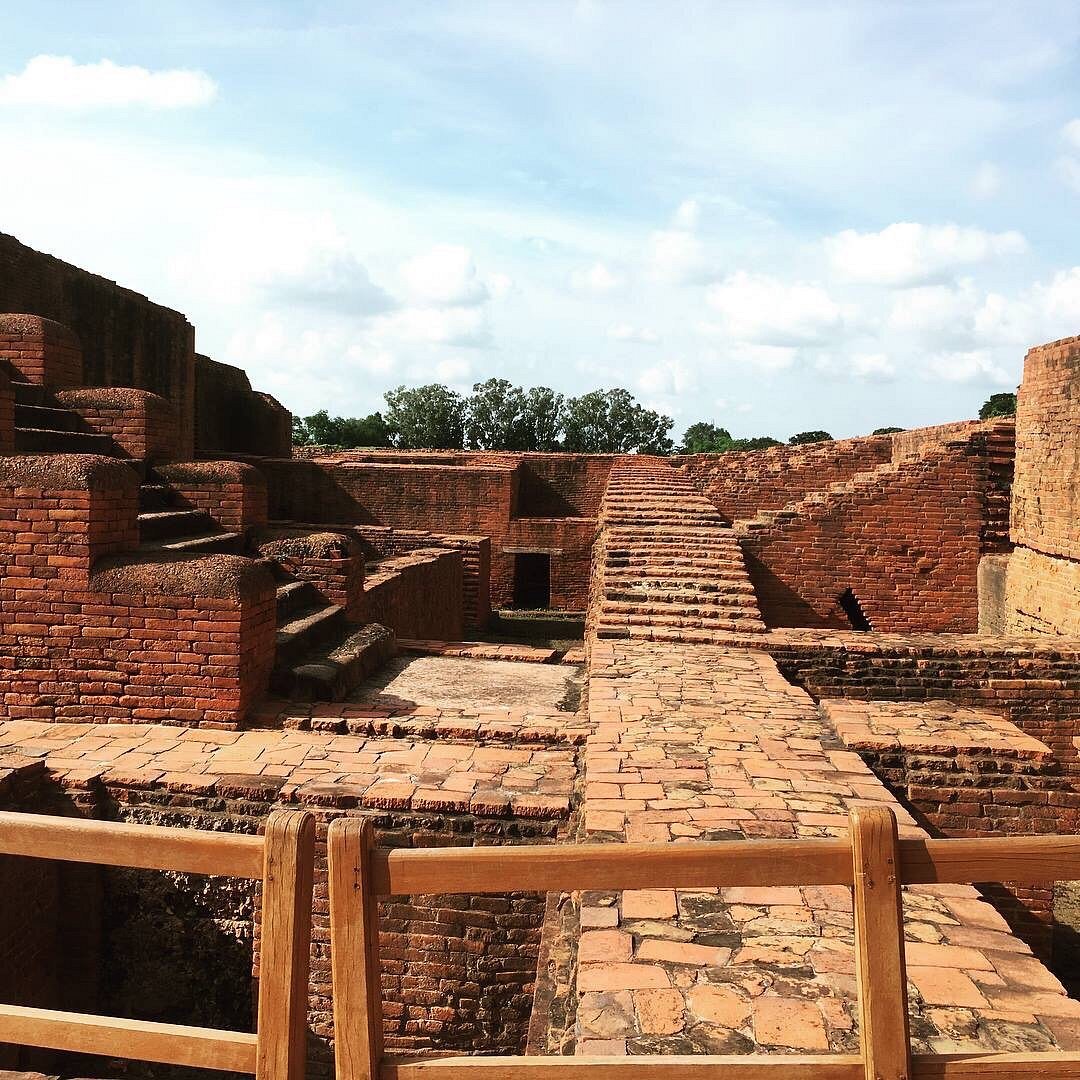
That long life matters. A visitor standing among ruins is not simply looking at old brickwork. They are looking at the remains of one of the strongest educational memories in Buddhist history. Nalanda represents endurance through teaching. Its importance comes from time as much as from fame.
Study, debate, and the long work of learning
The heart of Nalanda is intellectual seriousness. The site helps readers see that Buddhism once sustained communities in which reading and debate were not secondary. They were central. This makes Nalanda especially important because it preserves the idea that understanding requires labor. Moral thought needs institutions. Interpretation needs teachers. Learning needs structure.
That is why Nalanda often affects readers differently from other Buddhist places. It does not primarily move people through one sacred event. It moves them through the scale of sustained educational effort. The place says that a tradition becomes durable when it can teach itself clearly and renew its learning across generations.
Nalanda also changes the emotional feel of the Buddhist map. It is less about a turning point and more about a long discipline. Visitors are invited to think about teachers, students, routines of reading, and the patience required to preserve knowledge well. That quiet seriousness is part of what makes the site powerful.
Nalanda for Ambedkarites and readers
Nalanda matters strongly for Ambedkarites because education is not a side theme in Ambedkarite life. It is one of its central disciplines. Babasaheb's own life made that plain. He read widely, wrote extensively, and treated learning as essential to dignity, argument, and freedom. Nalanda belongs naturally beside that ethic. It shows that Buddhism too has a history of disciplined study at a very high level.
For Ambedkarite readers, that connection can be deeply affirming. Nalanda says that the turn toward Buddhism does not mean leaving reason behind. It means entering a tradition that has long taken study seriously. That matters because Ambedkarite Buddhism is not content with symbolic belonging. It asks for understanding, reading, and moral clarity.
There is also an emotional side to this. Nalanda can widen the sense of inheritance. It helps modern Buddhist and Ambedkarite readers feel that they are not entering a small or recent tradition, but one that once built major institutions of learning and left a strong intellectual mark on history.
The ruins of Nalanda matter because they make the scale of the institution more legible than a book summary can. A visitor begins to sense that this was not a symbolic center in name alone. It was a substantial educational world. The remains do not recreate that world completely, but they do enough to show its seriousness and its physical breadth.
This is part of Nalanda's special force. The site does not rely only on memory carried in text. It still has material weight. That weight is important for readers who want to feel that Buddhist intellectual history was not abstract. It had buildings, patterns of residence, planned space, and institutional form.
Visiting Nalanda today
Nalanda is usually reached through Patna, Bihar Sharif, or Rajgir. The site is straightforward to include in a Bihar Buddhist itinerary, especially if the trip already includes Rajgir. The figures below are approximate and are best used as planning guidance rather than fixed rates.
| Starting point | Approx. distance | Approx. time | Approx. taxi fare |
|---|---|---|---|
| Patna side | 74 km | 1 hr 15 min | Rs. 1,200-1,500 |
| Bihar Sharif Railway Station | 14-16 km | 25-35 min | Rs. 250-400 |
| Rajgir | 14-15 km | 25-30 min | Rs. 300-450 |
For many visitors, Rajgir and Nalanda are best understood together, since one helps explain early Buddhist setting and the other helps explain Buddhist learning.
Nalanda is a place that rewards a patient visit. The site can feel quiet at first, especially to visitors expecting more dramatic sacred architecture. But that quietness is part of the meaning. Nalanda is about duration, order, and intellectual labor. A slower visit makes those qualities easier to feel.
It also helps to approach the site with some awareness that ruins of learning do not speak in the same way as sites of birth or awakening. They ask the visitor to imagine continuity: students arriving, teachers explaining, arguments continuing, books being read, and an institution trying to preserve a tradition clearly. Nalanda grows stronger when approached with that imagination.
At Nalanda, visitors often experience a different kind of seriousness from the one they feel at places like Bodh Gaya. Here the tone is less about one decisive spiritual moment and more about the long discipline of understanding. The ruins ask quieter questions. What does it take to build a tradition of study? What kind of moral and intellectual patience is needed to preserve knowledge over time?
For Ambedkarite visitors, those questions can feel especially close because they echo the place of books, reading, and examination in Ambedkarite public life. Nalanda is one of the Buddhist places where that connection can be felt without strain.
Nalanda becomes especially strong in an Ambedkarite reading when it is linked not only to Buddhist history but also to Ambedkar's own moral insistence on education. A page like Books by B. R. Ambedkar sits naturally beside Nalanda because both are about learning as a mode of freedom. The point is not to make a false direct link. The point is to recognize a shared seriousness about study.
That is why Nalanda feels important beyond heritage. It helps Ambedkarite readers see that Buddhism has intellectual depth, institutional memory, and a long educational history. That recognition can strengthen both confidence and responsibility.
Related places
From Nalanda, continue to Rajgir for the older Magadha landscape, or return to Bodh Gaya to reconnect learning with awakening. The full places hub keeps those paths together.
Nalanda remains one of the clearest places where Buddhism can be read as a disciplined culture of learning. It does not depend on spectacle. It depends on the visible memory of study. For Buddhist visitors it widens the tradition. For Ambedkarite visitors it confirms that education belongs naturally inside Dhamma. That is why Nalanda still matters.