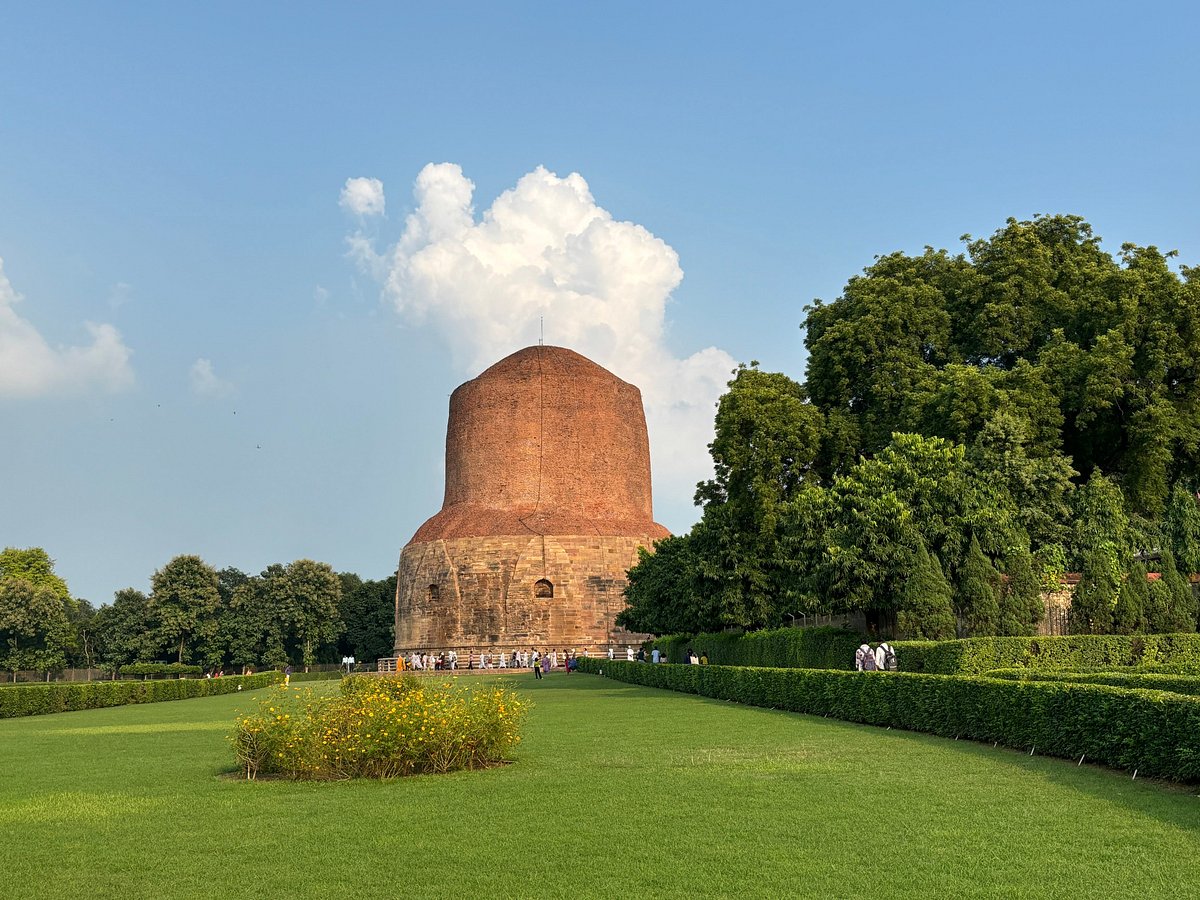
Why Sarnath matters
Sarnath matters because it marks the point where the Buddhist path became public teaching. The Buddha's awakening at Bodh Gaya was decisive, but Sarnath is where that understanding first entered speech, guidance, and shared path. That makes the place central for anyone who wants to understand Buddhism not only as personal insight, but as a teaching offered to others.
This gives Sarnath a distinctive tone. It is the place where the path became communicable, where understanding became guidance, and where Dhamma began to move outward into community. That public beginning is what gives Sarnath its force.
Sarnath is located near Varanasi in Uttar Pradesh and remains one of the most recognized sites in Buddhist sacred geography. It is tied closely to the memory of the first sermon and to the early public life of the Buddhist teaching. Because of that, the place continues to attract pilgrims, students, historians, and readers who want to understand not only what the Buddha realized, but how that realization first entered public instruction.
The site today combines ruins, stupas, monastic memory, museum culture, heritage preservation, and reflective walking space. That layered quality helps the place feel historically grounded without feeling sealed off from the present.
Sarnath became one of the core Buddhist sites because it was remembered as the place where the Buddha first taught after awakening. That memory shaped the growth of monasteries, stupas, sacred structures, and later archaeological interest. The site therefore matters not only because of a remembered sermon, but because generations of Buddhists continued to preserve it as the public beginning of Buddhist teaching.
This long continuity matters. It shows that Sarnath was never just a place mentioned in early texts and then forgotten. It remained part of a living sacred geography, and that continued return is one reason the site still speaks so strongly today.
The place of the first sermon
The deepest meaning of Sarnath lies in the fact that the Buddha's understanding did not remain private. Here, the teaching was first given shape in words, direction, and path. This matters because Buddhism is not only about personal realization. It is also about communication, guidance, and shared moral life.
That is why Sarnath continues to matter so much. It keeps close the moment when Dhamma first entered public speech. For many visitors, that makes the site feel especially alive. It is not just about remembering what the Buddha understood. It is about remembering that he taught it.
Sarnath often feels different from the other core sites because it carries a public mood even in silence. The place is shaped by the memory of teaching entering the world. Visitors are not only near the memory of a profound inner understanding. They are near the first moment that understanding was offered outward as shared guidance.
That is one reason Sarnath can matter so much to Ambedkarite readers. The site makes the public life of Dhamma visible from the beginning.
Sarnath for Ambedkarites and visitors
Sarnath matters for Ambedkarites because Ambedkarite Buddhism depends on Dhamma being taught, understood, and carried into public life. Ambedkar did not return to Buddhism for private spiritual comfort alone. He returned to it because he believed it could guide moral and social transformation. Sarnath therefore has strong interpretive value: it marks the place where understanding became teaching.
This matters especially in Ambedkarite reading because the movement is built around study, speeches, public explanation, and collective moral education. Sarnath helps connect that modern emphasis to the older Buddhist source. It reminds readers that Dhamma was from the beginning something to be spoken, understood, and shared in community.
That is why Sarnath belongs naturally beside places such as Deekshabhoomi. Deekshabhoomi marks a modern public turning toward Buddhism. Sarnath marks the first public teaching of Buddhism itself. Together they make the public dimension of the path easier to understand.
The Dhamek Stupa and the surrounding archaeological area give Sarnath much of its visible form. Visitors often experience the site through walking, observation, quiet attention, and the sense of being inside one of the earliest public Buddhist spaces. The physical setting matters because it allows the memory of teaching to remain grounded in place rather than abstraction.
This is one reason Sarnath feels different from a museum alone. The place still carries the atmosphere of a site where a path began to move into public history.
Visiting Sarnath today
Today, Sarnath is visited by pilgrims, Buddhist communities, students, and travelers from India and beyond India. The atmosphere combines sacred memory with historical curiosity and quiet movement through the site. That combination makes it especially good for readers who want to understand how Buddhist teaching took public shape.
For Ambedkarite visitors, Sarnath can deepen the meaning of pages such as What Is Buddhism?, The Buddha and His Dhamma, and How to Practice Ambedkarite Buddhism. It helps connect study and public teaching back to one of their oldest Buddhist sources.
Sarnath can be reached fairly easily from Varanasi, which is one reason many visitors include it as part of a broader Buddhist or historical journey. The practical ease of reaching the site matters because it allows first-time readers and pilgrims to place a major Buddhist teaching site within actual travel rather than distant imagination.
The table below gives a simple planning view. Distances and taxi fares are approximate and can change with traffic, demand, and service type, but they remain useful as a starting point.
| Starting point | Approx. distance | Approx. time | Approx. taxi fare |
|---|---|---|---|
| Varanasi Airport (VNS) | 23.9 km | 25 min | Rs. 500-650 |
| Varanasi Junction Railway Station | 8.7 km | 9 min | Rs. 210-260 |
| Varanasi city side | 8-10 km | 15-25 min | Varies by pickup point |
The site's accessibility matters because a place so central to the first teaching of Dhamma should remain reachable enough for study, pilgrimage, and return.
Sarnath is strongest when it is given enough time to be read slowly. Some visitors value calm hours for walking and reflection. Others prefer busier periods because the site then feels more visibly connected to living Buddhist practice. In either case, the place rewards attention more than hurry.
Visitors should approach the ruins, stupas, and sacred area with respect and quietness of mind. Practical arrangements can change across parts of the site, so timing should be checked before detailed planning. The deeper guideline stays simple: come ready to observe how teaching can still remain present in a place long after the first spoken words have passed.
At Sarnath, visitors often experience a sense of public beginning. The site does not mainly speak through drama. It speaks through clarity. Walking there can make the Buddhist path feel less like a private insight and more like a teaching offered into the world.
For Ambedkarite visitors, that can be especially meaningful because so much of Ambedkarite public life depends on reading, teaching, speaking, and explaining. Sarnath helps show that this public dimension has deep Buddhist roots.
Related places
From Sarnath, continue to Bodh Gaya for the place of awakening, to Kushinagar for mahaparinirvana, or to Deekshabhoomi to see how Buddhism was publicly re-entered in modern Ambedkarite history. The full places hub lets you continue from there.
Sarnath is not only one sacred stop among many. It is one of the places that keeps the Buddhist path public from the beginning. For Buddhists it marks the first sermon. For Ambedkarite readers it helps preserve the idea that Dhamma must be understood, taught, and carried into shared life. To visit Sarnath well is to remember that awakening was always meant to become teaching.