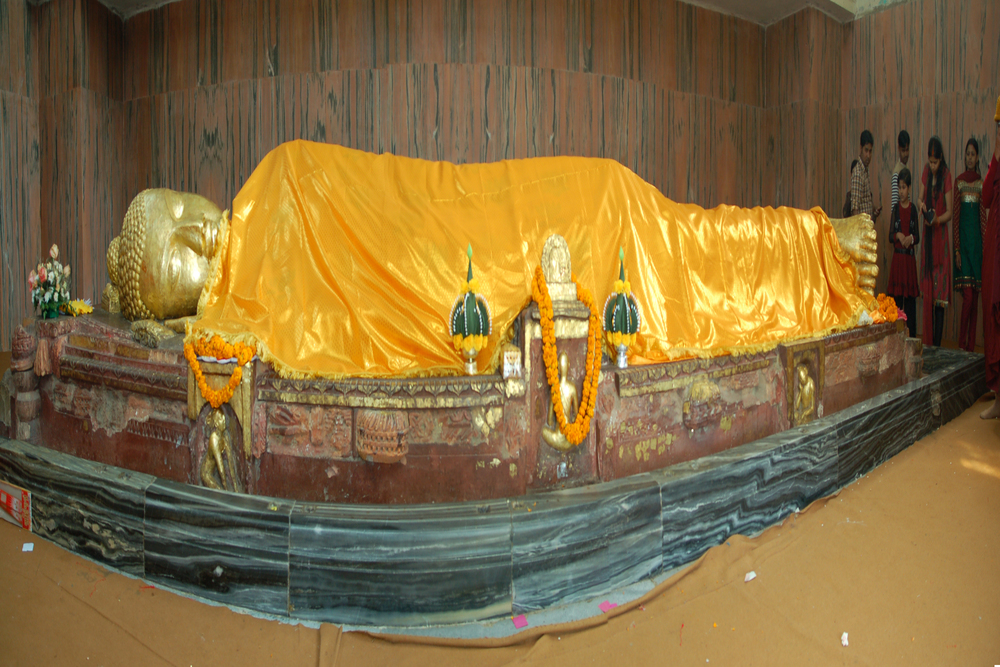
Why Kushinagar matters
Kushinagar matters because it marks the place of mahaparinirvana. That gives the site a tone different from Lumbini, Bodh Gaya, or Sarnath. It is not mainly about beginning, awakening, or first teaching. It is about final passing and what the Buddhist path means in the face of mortality, impermanence, and continuation beyond a teacher's physical presence.
This is one reason Kushinagar has such a particular force. The site does not only ask visitors to remember that the Buddha died. It asks them to think about what it means for a path to endure after the life of the one who taught it. That makes Kushinagar both solemn and clarifying.
Kushinagar is in Uttar Pradesh and is centered around the Mahaparinirvana Temple area and related sacred sites. It has long been treated as one of the four main places in Buddhist pilgrimage because it marks the final phase of the Buddha's earthly life. That place in the larger pilgrimage map is important because it allows a reader to see the Buddhist path not only through birth, awakening, and teaching, but also through final passing.
The site today combines pilgrimage, historical memory, quiet reflection, and heritage preservation. That layered quality helps keep Kushinagar from becoming only a solemn monument. It remains a place where people still return to think about impermanence, continuity, and the survival of teaching after death.
Kushinagar became one of the core Buddhist sites because it was remembered as the place where the Buddha entered mahaparinirvana. That memory shaped pilgrimage, sacred architecture, monastery life, and later preservation efforts around the site. Its importance therefore comes not only from a single remembered moment, but from the long tradition of Buddhists who continued to return to it as the place of final passing.
This continuity matters because it shows that the site remained central to Buddhist understanding across time. Kushinagar was not treated as a marginal endpoint. It was treated as essential to the meaning of the path itself.
The place of mahaparinirvana
The deepest meaning of Kushinagar comes from mahaparinirvana. The site asks visitors to think not only about death, but about the relation between ending and continuity. The Buddha's physical life ends, but the path does not end with it. That tension gives Kushinagar its moral seriousness.
For many visitors, this is what makes the site so powerful. It does not allow Buddhism to be read only as inspiration or teaching in the living moment. It also asks what endures when the teacher is gone. In that sense, Kushinagar keeps questions of loss, continuity, and fidelity very close.
Kushinagar often feels quieter and more solemn than the other core Buddhist sites, and that difference is part of its meaning. The place does not work through the energy of beginning or first teaching. It works through reflection on ending, continuity, and the enduring life of Dhamma after the teacher is gone.
For Ambedkarite readers, that solemnity can be valuable. It gives room to think about what survives a life of teaching and struggle, and what kind of responsibility falls on those who remain after such a life has ended.
Kushinagar for Ambedkarites and visitors
Kushinagar matters for Ambedkarites because Ambedkarite public life has always been deeply concerned with continuity after loss. A movement must learn how to continue after the death of its greatest teacher. Kushinagar gives older Buddhist depth to that question. It shows that the path remains alive not because a teacher remains physically present, but because people continue to carry, study, and live what was taught.
This matters in Ambedkarite reading because Babasaheb too is remembered through places such as Chaityabhoomi, where grief and continuity are held together in public life. Kushinagar does not stand in direct biographical relation to Ambedkar, but it helps make one part of Ambedkarite public memory more intelligible. It shows that remembrance is not only about loss. It is also about keeping a path alive after loss.
This is why Kushinagar belongs naturally beside Chaityabhoomi as well as the other core Buddhist sites. One belongs to the older Buddhist sacred geography of final passing. The other belongs to modern Ambedkarite public remembrance. Both ask what it means for a life to continue in community after death.
The Mahaparinirvana Temple and the related sacred spaces give Kushinagar much of its visible form. Visitors often experience the site through quiet movement, observation, and a heightened sense of finality without despair. The physical setting matters because it helps keep the meaning of mahaparinirvana close to place, body, and memory.
This is one reason Kushinagar feels distinct from a general heritage stop. The site still works as a place where impermanence and continuity can be thought together rather than separately.
Visiting Kushinagar today
Today, Kushinagar is visited by pilgrims, Buddhist communities, readers, and travelers who want to understand the full shape of the Buddha's life story. The site often feels quieter than more crowded pilgrimage destinations, and that can help visitors reflect more slowly on the meaning of ending and continuity.
For Ambedkarite visitors, Kushinagar can deepen the meaning of pages such as What Is Buddhism?, The Buddha and His Dhamma, and Chaityabhoomi. It helps connect modern public remembrance to older Buddhist reflections on how a path survives after the death of a great teacher.
Kushinagar is often reached through Gorakhpur and nearby road travel. This practical route matters because many visitors include the site as part of a broader Buddhist pilgrimage circuit and need a simple sense of distance and travel time.
The table below gives a basic planning view. Distances and taxi fares are approximate and can change with traffic, demand, and service type, but they remain useful as a starting point.
| Starting point | Approx. distance | Approx. time | Approx. taxi fare |
|---|---|---|---|
| Gorakhpur Airport | 51.4 km | 48 min | Rideshare or road transfer |
| Gorakhpur Junction Railway Station | 54.1 km | 50 min | Rs. 1,300-1,600 |
| Gorakhpur city side | 55.8 km | 53 min | Rs. 1,300-1,700 |
The site's practical accessibility matters because one of the key places of mahaparinirvana should remain reachable enough for pilgrims, students, and readers who want to complete the wider Buddhist map.
Kushinagar is strongest when it is given time. Some visitors value calmer periods because they allow the site to be read slowly and inwardly. Others prefer busier periods when the collective life of pilgrimage is more visible. Both can be meaningful, but the place rewards patience more than speed.
Visitors should approach Kushinagar with respect, quietness, and seriousness. Practical arrangements can change, so timing should be checked before a detailed visit, but the deeper guideline remains simple: come prepared to reflect as well as to observe.
At Kushinagar, visitors often experience a quieter moral atmosphere than at sites associated with awakening or public teaching. The place works through reflection, solemnity, and the question of what it means for a path to continue after a teacher's death. That is part of its force.
For Ambedkarite visitors, this can be especially meaningful because it helps place modern movement remembrance inside a longer Buddhist reflection on loss, continuity, and responsibility after great lives have ended.
For an Ambedkarite reader, Kushinagar deepens the understanding that a path survives through memory, study, and continued practice after the death of its teacher. That is a crucial truth for any movement shaped by great lives. The value of Kushinagar is not ritual obligation. It is seriousness. The site helps place Ambedkarite continuity within a wider Buddhist reflection on what remains after loss.
Related places
From Kushinagar, continue to Sarnath for the first sermon, to Lumbini for the Buddha's birth, or to Chaityabhoomi to connect older Buddhist reflections on final passing with modern Ambedkarite public remembrance. The full places hub lets you continue from there.
Kushinagar is not only one more sacred site in the Buddhist map. It is one of the places that keeps close the question of what continues after a great life has ended. For Buddhists it marks mahaparinirvana. For Ambedkarite readers it gives older Buddhist depth to the work of continuity, remembrance, and responsibility after loss. To visit Kushinagar well is to let that seriousness remain with you.