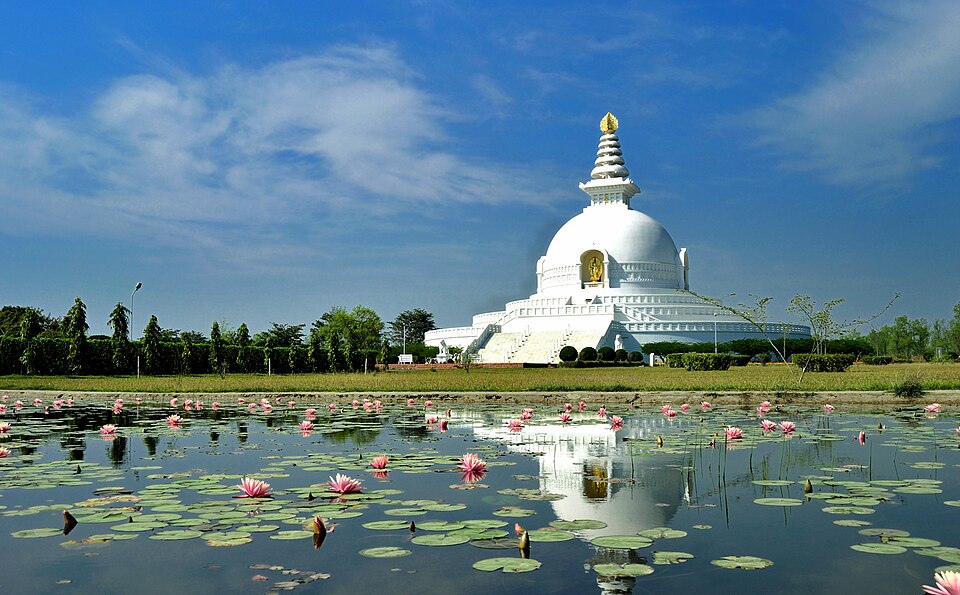
Why Lumbini matters
Lumbini matters because it marks the beginning of the Buddha's earthly life. That gives it a different tone from Bodh Gaya, Sarnath, or Kushinagar. It is not mainly the place of awakening, first teaching, or final passing. It is the place of birth. That difference is important because Buddhism does not begin in abstraction. It begins with a human being born into the world and later coming to understand that world in a transformative way.
This is one reason Lumbini continues to feel powerful even to readers who are not drawn first by ritual or pilgrimage. The site keeps visible the fact that the Buddha was not a distant supernatural figure dropped from outside life. He began within history, family, society, and human vulnerability. Lumbini keeps that fact close.
Lumbini is in Nepal and is centered around the Maya Devi Temple, the sacred garden, and the wider pilgrimage zone that has grown around the site over time. The place is now one of the most recognized destinations in Buddhist pilgrimage because it is directly tied to the Buddha's birth. That directness gives it unusual force. A visitor is not arriving at a loosely remembered region. They are arriving at one of the strongest anchors in Buddhist memory.
The site today brings together pilgrimage, archaeology, quiet reflection, heritage preservation, and international Buddhist presence. That layered life matters because it shows that Lumbini is not a dead historical location. It is an ancient place that continues to be read, visited, protected, and interpreted in the present.
Lumbini has been remembered and marked as a sacred site for centuries. It became part of a wider Buddhist pilgrimage geography because the Buddha's birth was treated as a world-changing human event, not merely as a private origin story. Monuments, inscriptions, sacred structures, and later archaeological work all helped keep that memory visible.
The Maya Devi Temple and the Ashokan connection are part of why the site remains so significant in historical terms. The place is not important only because tradition says the Buddha was born there. It is also important because the memory of that birth was preserved, marked, and revisited over long stretches of time. That continuity gives Lumbini both sacred and historical depth.
The beginning of the Buddha's life
The deeper meaning of Lumbini comes from birth itself. Birth may seem quieter than awakening or first teaching, but it matters because it makes the Buddhist path fully human from the beginning. The person who became the Buddha began as a child born into the conditions of the world. That fact keeps the later path tied to human life rather than divine distance.
For many visitors, this is what gives Lumbini its special power. The site asks people to remember that Buddhism begins not in abstraction, but in life as it is first received. It is one of the places that makes the whole Buddhist story more human, and therefore more real.
Lumbini often feels quieter than the other core Buddhist sites. That quietness is not an absence of meaning. It is part of the meaning. The place does not push visitors toward dramatic moments of decision in the same way that Bodh Gaya, Sarnath, or Deekshabhoomi can. Instead, it keeps the beginning of a life close and asks the reader to stay with that beginning long enough for it to matter.
For many people, this changes the pace of reading. Lumbini is less about turning points and more about origin. That difference gives the page, and the place itself, a different emotional center.
Lumbini for Ambedkarites and pilgrims
Lumbini matters for Ambedkarites because Ambedkarite Buddhism takes the Buddha seriously as a human moral teacher whose path remains relevant to life in society. Lumbini helps preserve that reading. It brings the Buddha back into a world of birth, human formation, social conditions, and lived experience. That matters to Ambedkarite readers because Ambedkar did not return to Buddhism to leave history behind. He returned to it in order to change life within history.
In that sense, Lumbini has quiet but deep value. It reminds Ambedkarite Buddhists that the path they look toward is not based on inherited hierarchy or divine distance. It begins with a human life and moves toward transformed understanding. That human beginning fits closely with Ambedkar's rational and ethical interpretation of Buddhism.
This is also why Lumbini belongs naturally beside Bodh Gaya. Lumbini marks the beginning of the Buddha's life. Bodh Gaya marks the awakening within that life. Together they help Ambedkarite readers see that the Buddhist path emerges from human reality and not from myth alone.
Lumbini remains a living pilgrimage site because people continue to return there not only to honor the past, but to place themselves inside a larger Buddhist continuity. The site is often quieter in tone than movement-centered Ambedkarite places, and that quiet can be part of its value. It gives a visitor room to think about origins, human life, and the beginning of a path rather than only its later public meaning.
For Ambedkarite visitors, this can be especially useful because it widens the Buddhist horizon without pulling them away from their own modern concerns. It shows that Ambedkarite Buddhism enters a long tradition, but enters it with a renewed ethical and social seriousness.
Visiting Lumbini today
The Maya Devi Temple and the surrounding sacred area give Lumbini much of its visible identity. Visitors often experience the site through a combination of archaeological seriousness, quiet movement, and devotional presence. The sacred garden, nearby structures, and the surrounding heritage zone help make the place feel both old and still active.
This combination matters because Lumbini should not be approached only as an old monument. It remains a place where people return to remember that the Buddhist path began in lived human life and has continued to shape moral imagination across centuries.
Today, Lumbini is visited by pilgrims, Buddhist communities, students, historians, and travelers from many countries. The atmosphere often feels quieter and more spacious than sites of mass movement gathering. That difference is important. Lumbini offers room to reflect on beginnings, human life, and the first place in the larger Buddhist story.
For Ambedkarite visitors, Lumbini often works best when read alongside pages such as What Is Buddhism?, The Buddha and His Dhamma, and What Is Navayana Buddhism. Then the place becomes part of a larger moral reading rather than a simple sacred stop.
Lumbini is usually reached through Bhairahawa or nearby road connections. For many visitors, this practical route matters because the site is often part of a wider Buddhist circuit and needs to be approached with simple planning rather than uncertainty.
The table below gives a basic planning view. Distances and taxi fares are approximate and can change with traffic, border movement, and service type, but they are useful as a starting point.
| Starting point | Approx. distance | Approx. time | Approx. taxi fare |
|---|---|---|---|
| Bhairahawa / Gautam Buddha International Airport side | 22-31 km | 26-31 min | $20-32 |
| Lumbini pillar inscription / Maya Devi Temple side approach | 22-23 km from Bhairahawa | 26 min | $20-24 |
| Lumbini local area | 1-3 km | 5-12 min | Local short ride / walk |
The practical side of reaching Lumbini matters because such a central site should still remain open to pilgrims, students, and ordinary readers who want to connect more directly with the Buddhist beginning.
The best visits to Lumbini are usually the ones that allow enough time for walking, observing, and returning to the site without hurry. Some visitors value periods when the place feels more visibly international and devotional. Others prefer calmer periods when the sacred garden and surrounding area can be read more slowly. Both approaches work, but Lumbini rewards patience more than speed.
Visitors should approach the place with quietness and seriousness. It remains an active place of Buddhist reverence as well as a heritage site. Local arrangements can change, so practical timing should be checked before a detailed visit, but the deeper guideline stays simple: come in a way that gives the beginning of the Buddhist path room to be felt.
At Lumbini, visitors often experience quiet more than drama. That quiet matters. It allows the site to be read through beginnings, atmosphere, walking, reflection, and a sense of the Buddha's human origin rather than through spectacle. For many people, that changes how the rest of the Buddhist story is understood.
For Ambedkarite visitors, this can sharpen the sense that Buddhism begins from human life and moves toward moral and intellectual transformation. That human beginning is one reason Lumbini still matters in a modern reading of the Buddha.
Related places
From Lumbini, continue to Bodh Gaya for the place of awakening, to Sarnath for the first sermon, or to Deekshabhoomi to see how Buddhism was publicly re-entered in modern Ambedkarite history. The full places hub lets you continue from there.
Lumbini is not only a birthplace in sacred geography. It is one of the places that keeps the Buddhist path fully human from the start. For Buddhists it marks the beginning of the Buddha's life. For Ambedkarite readers it helps preserve a reading of Buddhism rooted in history, society, and lived human possibility. To visit Lumbini well is to remember that the path begins here before it widens elsewhere.