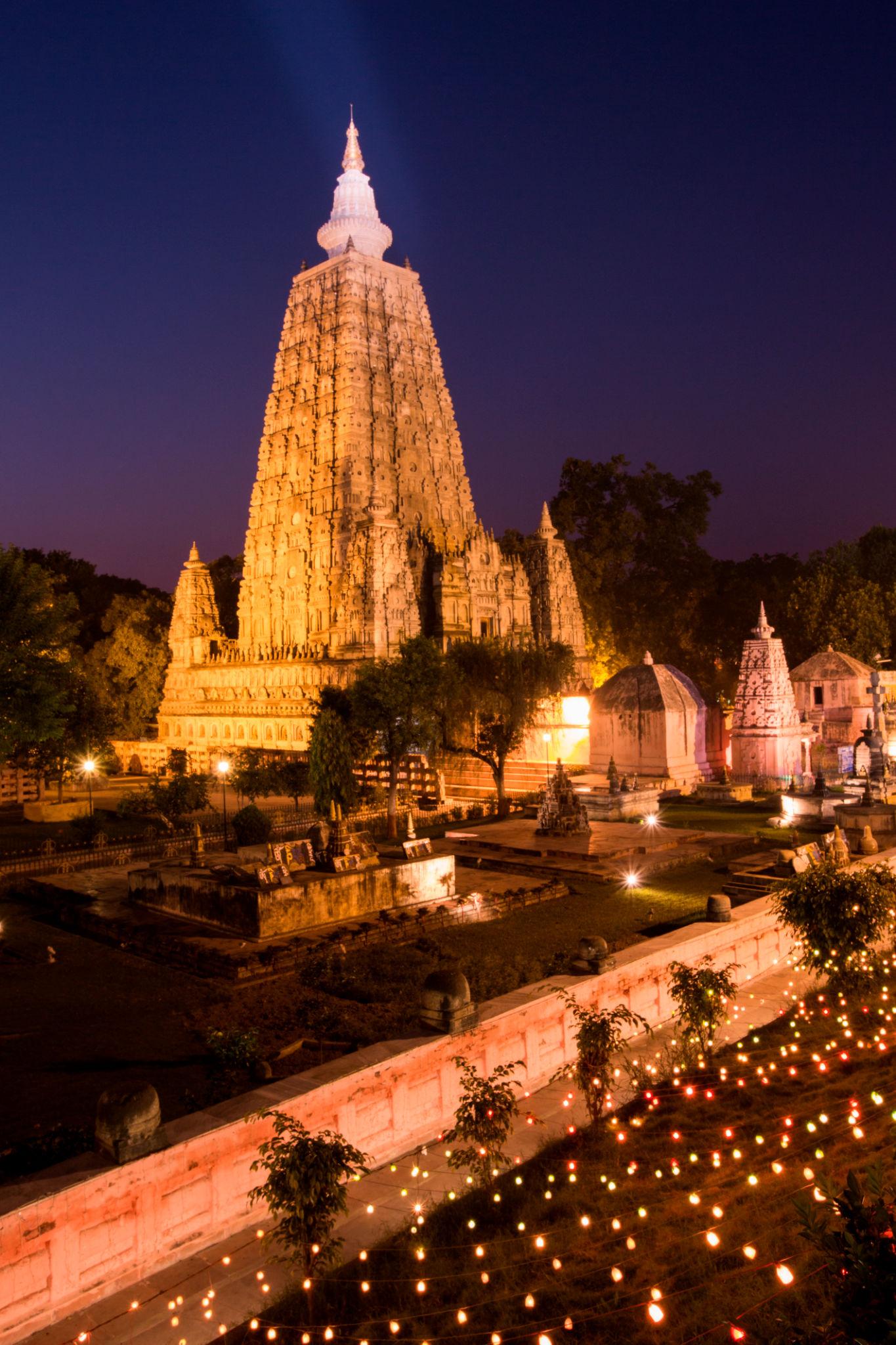
What Mahabodhi Temple is and where it stands
Mahabodhi Temple is a Buddhist temple in Bodh Gaya, Bihar, built near the spot where Gautama Buddha attained enlightenment. It is one of the oldest surviving brick temple structures in India and one of the strongest physical links between Buddhist memory and a real historical place.
The temple matters not only because it is old. It matters because it stands at a location already sacred in Buddhist memory before later structures were raised around it. In that sense, Mahabodhi Temple is both a monument and a marker. It marks the site of awakening, and it also shows how later Buddhist communities chose to preserve and honor that place.
Mahabodhi Temple is located in Bodh Gaya, Bihar, India, near the city of Gaya. For visitors planning a journey, this is one of the main reasons the temple is often searched together with “Bodh Gaya temple,” “Bihar Buddha temple,” and “Buddha enlightenment place.” The temple belongs directly to the Bodh Gaya sacred landscape and cannot really be separated from it.
The site is accessible by road from Gaya, by rail through Gaya Junction, and by air through the Gaya airport side. That relative accessibility is one reason it remains one of the most visited Buddhist pilgrimage places in the world.
History of Mahabodhi Temple
The history of Mahabodhi Temple begins with the memory of the Buddha’s enlightenment itself. According to Buddhist tradition, Siddhartha Gautama sat in deep meditation beneath the Bodhi Tree at this site and attained enlightenment there. That event is what made the place sacred. The temple came later as a way of protecting, marking, and honoring that sacred ground.
The site is also closely associated with Emperor Ashoka, who is remembered as playing an important role in recognizing and supporting the early sacred area connected with the Buddha’s awakening. Over time, the place changed through building, repair, decline, recovery, and restoration. The temple seen today therefore carries more than one historical layer. It is tied to ancient Buddhist memory, but it also reflects centuries of preservation and rebuilding.
This long history matters because Mahabodhi Temple is not a newly created symbolic site. It is part of a continuous effort across generations to keep the place of awakening visible and protected. That continuity gives the temple much of its force.
Why Mahabodhi Temple remains so important
Mahabodhi Temple remains important because it does something very specific: it gives built form to the memory of awakening. Visitors do not only think about the Buddha’s enlightenment in abstract terms. They move through a temple complex that has preserved that memory through structure, shrine, sacred ground, and ritual attention. This makes the place different from a general historical site. The complex itself is part of how the memory survives.
The temple also matters because it gathers several layers into one place at once. It is a pilgrimage center, an architectural landmark, a historical monument, and an active Buddhist sacred space. The importance of the temple is not only that awakening happened there once. It is that the site has continued to hold, protect, and present that memory in visible form for generations.
Mahabodhi Temple is recognized as a UNESCO World Heritage Site, and that recognition matters because it acknowledges the temple’s global cultural and spiritual importance. The site is not only important to Buddhists. It is also important to world heritage because it preserves a place central to human religious history.
UNESCO recognition also highlights the importance of preservation. A place like Mahabodhi Temple must be protected not only because it is ancient, but because it continues to hold living meaning for millions of people. Its value lies in both history and present use.
The temple, the Bodhi Tree, and the sacred complex
The architecture of Mahabodhi Temple gives the site much of its visible identity. The main temple structure rises in a tall pyramidal form that is one of the most recognizable silhouettes in Buddhist architecture. It does not feel modest or hidden. It feels intentionally public, vertical, and centered on the sacred ground around it.
Around the main temple are smaller stupas, shrines, and associated structures that deepen the sense of accumulated devotion. These surrounding elements matter because they show that the site was never only a single building. It became a sacred complex shaped by repeated acts of reverence and preservation. The carved and historical elements around the temple also help explain why it works both as a pilgrimage site and as a major heritage monument.
Inside the complex, the main shrine with the Buddha statue is one of the first places that draws attention. The Vajrasana, or Diamond Throne, carries its own special significance because it is closely linked with the memory of enlightenment. Behind the temple, the Bodhi Tree area forms another center of gravity. Many visitors move between these spaces rather than staying in one fixed point, and that movement is part of how the complex is experienced.
This is also where the page naturally connects with the Bodhivriksha Tree. The Mahabodhi Temple and the Bodhi Tree belong together in Buddhist memory, but they do not do the same work. The temple gives lasting architectural form to the sacred site. The tree preserves the living symbol of awakening beside it.
The complex therefore works in layers. Some people come for worship, some for study, and some for meditation. The site can hold all of these approaches at once, which is part of what makes it so enduring.
Pilgrimage and visiting today
People visit Mahabodhi Temple from across the world because it is one of the strongest pilgrimage points in Buddhism. For many, the site offers a rare combination of inner quiet and global visibility. One can sit in meditation, listen to chanting, observe monks and lay visitors, and feel that the temple is still part of a living religious world rather than a frozen monument.
That experiential side matters. Mahabodhi Temple is not only famous because of a historical event. It is also famous because the site still allows people to approach awakening as a living question. That gives the place its spiritual seriousness.
The cooler months are usually the easiest time to visit because the weather is more manageable for walking, sitting, and spending longer hours around the complex. Festival periods such as Buddha Purnima can be especially meaningful because the site feels more intense and globally alive, though also much more crowded.
Some visitors prefer these larger public moments, while others prefer quieter days when the complex can be experienced more slowly. Both approaches have value. The best time depends on whether one wants a larger collective atmosphere or more inward calm.
Mahabodhi Temple is usually reached through Gaya and Bodh Gaya town. Visitors can arrive by air via Gaya, by train through Gaya Junction, and by road from nearby Bihar routes. Because it is one of the best-known Buddhist pilgrimage destinations, the route is relatively straightforward compared with some quieter sites.
| Starting point | Approx. distance | Approx. time | Approx. taxi fare |
|---|---|---|---|
| Gaya Airport | 8 km | 8-15 min | Rs. 220-270 |
| Gaya Junction Railway Station | 15-17 km | 25-40 min | Rs. 350-500 |
| Bodh Gaya town side | 1-3 km | 5-12 min | Rs. 40-120 |
The practical accessibility of the temple is one reason the site remains central in modern Buddhist pilgrimage.
Mahabodhi Temple and the wider Bodh Gaya world
Mahabodhi Temple and Bodh Gaya belong together. The temple gives architectural form to the sacred site, while Bodh Gaya names the wider place of awakening. That is why this page works best alongside the broader Bodh Gaya page. If you want to move outward from the temple into the larger Buddhist geography, the next natural stop is the directory of important Buddhist and Ambedkarite places.
Bodh Gaya also includes many monasteries, temples, and international Buddhist presences around the central complex. This wider setting makes the temple feel both rooted and global at once.
Mahabodhi Temple in Ambedkarite Perspective
For Ambedkarite Buddhists, Mahabodhi Temple matters not because it represents ritual prestige, but because it marks the site of awakening. In Ambedkarite reading, awakening can be understood as knowledge, clarity, rational understanding, and liberation from ignorance. That makes the place deeply meaningful even though it is not a modern Ambedkarite movement site like Deekshabhoomi.
The temple can therefore be read as part of the older Buddhist world to which Ambedkar returned. It helps explain what his turn to Dhamma was toward: wisdom, moral clarity, and a path beyond suffering shaped by understanding rather than blind belief. That is why Mahabodhi Temple belongs naturally beside pages such as What Is Buddhism?, Bodhivriksha Tree, and Why Ambedkar Chose Buddhism.
Conclusion
Mahabodhi Temple is not just an old monument in Bihar. It is one of the places where one of the most important spiritual transformations in history is remembered in living form. It continues to inspire people because it joins wisdom, peace, architecture, memory, and awakening in one real place. That is why the temple remains central to Buddhist pilgrimage and still matters to readers trying to understand Buddhism seriously today.