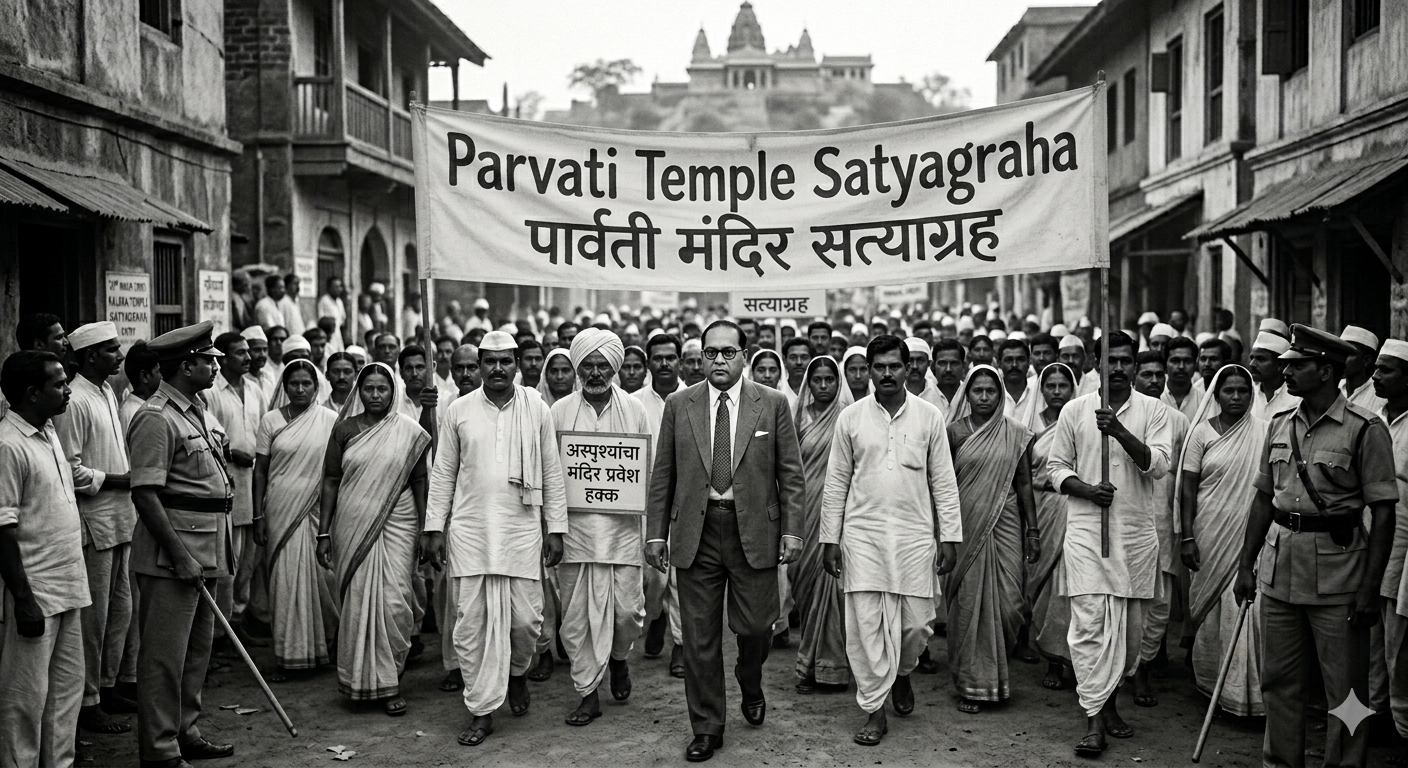
Background of the satyagraha
The problem behind the Parvati Temple Satyagraha was temple exclusion on caste grounds. Dalits were denied entry not because of conduct or belief, but because caste society treated them as permanently inferior. Temple entry thus became a public sign of larger social inequality.
The satyagraha was needed because social discrimination could not be challenged only in speeches and books. It had to be challenged at the actual doors where society announced who counted and who did not. The Parvati struggle did that in a clear and public way. A temple open to some and closed to others by birth was not only a religious question. It was a statement about status, honor, and public humanity.
Before the satyagraha began, organizers in Pune formed a committee to press for temple entry, with figures such as Shivram Janaba Kamble and P. N. Rajbhoj playing important roles in the local effort. That detail matters because it shows that Parvati was not a vague symbolic idea. It was an organized public campaign shaped within the wider Ambedkarite movement.
Parvati also belongs to the larger development of Ambedkar's public method. After movements such as Mahad Satyagraha and the ideological challenge of Manusmriti Dahan, temple-entry struggles made visible how caste operated through religion as well as civic life. Parvati helped extend that struggle into sacred space and public respectability.
What happened during the movement
On 13 October 1929, a satyagraha was begun around the Parvati temple complex in Pune. The movement brought together people who wanted to challenge caste restrictions on entry and to expose the contradiction between religious claims and social practice. As in other temple-entry struggles, the movement faced strong opposition from those committed to preserving caste hierarchy.
The action mattered because it made exclusion visible in a place where caste society preferred to treat it as normal or sacred. Once entry was claimed publicly, refusal itself became a public fact rather than a hidden custom. That was one of the central functions of Ambedkarite satyagraha: it forced society to show the shape of its injustice in public view.
Contemporary accounts and later historical references note that orthodox opponents attacked the satyagrahis as they moved toward the temple and that P. N. Rajbhoj was seriously injured. That resistance is historically important because it showed how fiercely caste society defended exclusion even when the claim being made was simply equal entry into sacred space.
Parvati also mattered because it was part of a developing pattern rather than an isolated episode. It helped show that temple-entry struggles were becoming an important field of anti-caste action. Even where immediate entry was blocked, the movement widened public scrutiny and taught oppressed communities that a closed gate could still become a site of collective assertion and political education.
Role of B. R. Ambedkar
Ambedkar's role in temple-entry satyagrahas was to turn them into questions of self-respect and equal status rather than mere requests for religious permission. In that sense, the Parvati movement was part of a wider strategy. It told oppressed communities that silence could not produce equality, and it told caste society that exclusion would now be challenged openly.
He also gave such movements their larger meaning. Temple entry was not, for him, the final answer to oppression. But it was a powerful way to reveal the hypocrisy of a society that spoke of morality while denying equal worship on the basis of birth. That is why Parvati should be read not as an isolated local protest, but as part of Ambedkar's effort to expose caste where it claimed moral and religious legitimacy.
Key outcomes
The Parvati Temple Satyagraha helped widen the anti-caste movement beyond civic access questions and into symbolic sites of purity and hierarchy. It increased awareness, sharpened public debate, and prepared the ground for later temple-entry actions, especially the better-known Kalaram movement.
It also showed that public resistance would continue even when immediate success was denied. That persistence mattered. It told oppressed communities that every blocked gate could still become a site of political education and collective assertion. In that way, Parvati contributed to the larger growth of disciplined Ambedkarite public action.
The movement also helped make clear that caste exclusion in worship was not secondary. It was one more place where inequality was rehearsed and defended. By contesting that exclusion, the satyagraha expanded the field of anti-caste struggle and made later movements easier to imagine and organize.
Historical significance
The significance of the Parvati struggle lies in the way it expanded the field of resistance. It showed that anti-caste action was not limited to legal claims or public water. It also had to confront religious exclusion where caste attempted to make inequality appear holy.
For that reason, the movement deserves to be remembered not as a minor footnote before Nashik, but as one of the important steps through which temple entry became a major anti-caste issue in Ambedkar's public struggle. Parvati matters because it helped define the path by which public struggle moved into temple space and made caste answerable there as well.
Timeline
| Year | Event |
|---|---|
| 22 September 1929 | Organizers in Pune form a committee and prepare the satyagraha for temple entry. |
| 13 October 1929 | The satyagraha begins around the Parvati temple complex in Pune. |
| 1929 | The movement publicly challenges caste restrictions on temple entry and exposes religious exclusion as a question of equality and status. |
| 1929-1930 | The struggle continues as part of the larger pressure for temple entry and social equality. |
| After 1929 | Parvati remains an important early step in the temple-entry strand of Ambedkar's public anti-caste movement. |
Related movements
Parvati should be read alongside Kalaram Temple Satyagraha. For the earlier civic assertion that shaped Ambedkar's public method, continue to Mahad Satyagraha.
Location
Pune, Maharashtra, around the Parvati temple complex.
Questions about the Parvati Temple Satyagraha
What was the Parvati Temple Satyagraha?
The Parvati Temple Satyagraha was a 1929 temple-entry struggle in Pune associated with Ambedkar's movement to challenge caste-based exclusion from sacred space.
Why was the Parvati Temple Satyagraha important?
The Parvati Temple Satyagraha was important because it made temple entry a public question of equality, dignity, and caste exclusion in religious space.
Where did the Parvati Temple Satyagraha take place?
The Parvati Temple Satyagraha took place around the Parvati temple complex in Pune, Maharashtra.
How is Parvati connected to other Ambedkarite satyagrahas?
Parvati is connected to other Ambedkarite satyagrahas because it carried the anti-caste struggle from civic and ideological questions into temple-entry and religious exclusion, helping prepare the ground for later movements such as Kalaram.
Suggest updates
If you notice a missing detail or want to suggest a correction with reliable evidence, please use our Contact Us page so the record can be reviewed carefully.
Conclusion
The Parvati Temple Satyagraha remains important because it made temple entry a question of equality and public dignity. It showed that caste exclusion could not hide behind religious custom forever.