Background of the satyagraha
The problem behind Manusmriti Dahan was not only social practice but also ideological authority. Caste did not survive through custom alone. It also drew force from texts and interpretations used to justify graded inequality. For Ambedkar, this meant that social reform could not stop at asking for kinder behavior. It had to challenge the intellectual and religious basis of oppression.
Babasaheb Ambedkar opposed Manusmriti because it was widely treated as a source of authority for caste hierarchy and social inequality. In his view, a text that was used to place some people above others by birth, and to justify humiliation as social order, could not be accepted as morally legitimate. That is why opposition to Manusmriti was not a side issue for him. It was part of the larger struggle against the ideas that kept caste alive.
The satyagraha was needed because caste society often defended injustice by treating it as sacred order. So long as such authority remained untouched, humiliation could be presented as duty and inequality could be made to appear moral. Manusmriti Dahan therefore became necessary as a public act of moral and political refusal.
It also needs to be read in relation to Mahad Satyagraha. Once the denial of water had been challenged in public, the movement could not stop with civic access alone. It had to ask what ideas and authorities made such exclusion seem legitimate in the first place. Manusmriti Dahan emerged from that deeper question.
What happened during the movement
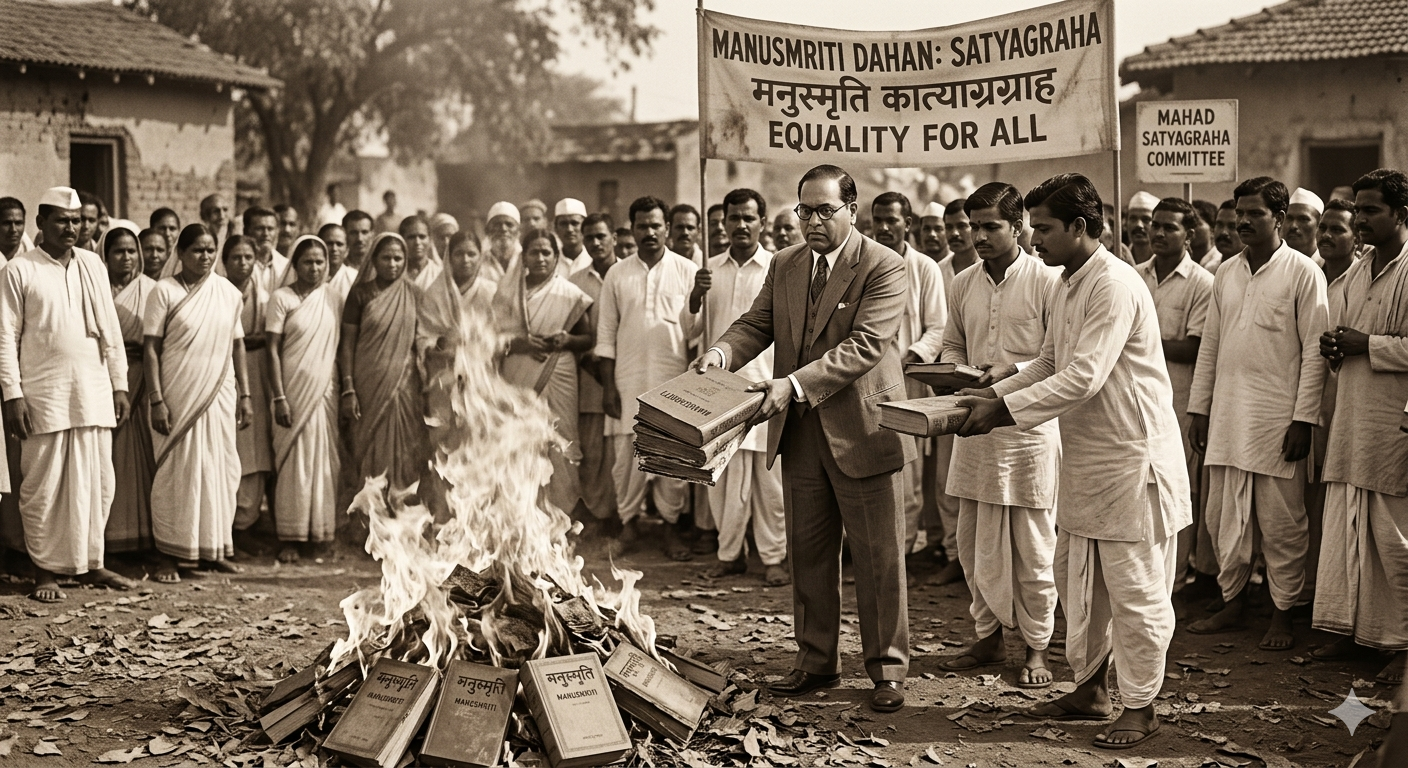
In December 1927, within the wider Mahad struggle, Manusmriti was publicly burned. The action did not appear out of nowhere. It followed a year in which caste exclusion had already been exposed in public through the struggle over the Chavdar Tank. By the time of Manusmriti Dahan, the movement had already shown that caste denied basic civic rights. The next step was to challenge the authority used to defend that denial.
The public burning declared that a text invoked to justify hierarchy and untouchability could not be accepted as a moral authority for a just society. It was not a casual act of destruction. It was a deliberate and carefully framed rejection of a social order rooted in inequality by birth. The action made visible that the anti-caste movement would not leave scriptural prestige untouched when that prestige was used against human dignity.
This is why the event remains so important. It connected social protest with intellectual critique. It said that if a text is used to deny dignity, then challenging that text becomes part of the struggle for equality. Manusmriti Dahan therefore widened the meaning of satyagraha itself. The movement was no longer only exposing discrimination in public life. It was also refusing the moral language through which caste tried to justify itself.
Role of B. R. Ambedkar
Ambedkar's role was decisive because he made clear that caste could not be ended without confronting the beliefs that supported it. He understood that ritual humiliation, denial of access, and social hierarchy all rested on deeper structures of legitimacy. Manusmriti Dahan gave public form to that understanding.
By placing this action within the movement around Mahad, he also showed that rights and ideas are connected. The fight for water rights and the rejection of caste scripture were not separate struggles. They belonged to the same moral logic, because a society that denies equal civic standing usually does so with some claim of moral or religious legitimacy behind it.
Ambedkar's leadership here was also important because he gave the action its public meaning. Without that clarity, the burning could have been dismissed as anger alone. He framed it instead as an ethical and political refusal. He made clear that the issue was not hatred of books as such, but rejection of a text when it is used to justify inequality, degradation, and permanent hierarchy by birth.
That is why his role cannot be reduced to presiding over a dramatic gesture. He understood the structure of caste power clearly and knew that public humiliation survives longer when it can claim intellectual respectability. Manusmriti Dahan stripped that respectability away in one unmistakable act, and Ambedkar ensured that the movement understood exactly why that act mattered.
Key outcomes
Manusmriti Dahan sharpened the ideological edge of Ambedkar's movement. It showed that anti-caste struggle would not remain satisfied with mild reform or polite criticism. It would also challenge the authority of beliefs and texts used to legitimize inequality. That made the movement intellectually clearer and politically firmer.
The action also gave the movement a stronger public identity. It made visible that the struggle was not only for access to tanks, roads, schools, and temples, but also for a different moral order. In that sense, Manusmriti Dahan helped people see that caste was not only a matter of daily discrimination. It was a whole system of justification that had to be rejected.
That is one reason the event remains so widely remembered. It condensed a larger argument into one unmistakable public act: a society cannot claim justice while honoring a moral authority used to keep people unequal by birth. It also prepared the ground for later Ambedkarite thought by making open critique of caste scripture part of public political life.
Historical significance
The historical significance of Manusmriti Dahan lies in its clarity. It rejected the idea that oppression becomes respectable when it is dressed in scriptural language. That is why the event remains central in Ambedkarite memory. It turned a battle against caste practice into a battle against caste legitimacy.
It is also significant because it helped define Ambedkar's public method more fully. He did not separate social suffering from the ideas that defended it. He confronted exclusion in lived space, as at Mahad, and then confronted the intellectual authority behind it. That larger pattern is part of what gives Manusmriti Dahan its continuing force.
Timeline
| Year | Event |
|---|---|
| March 1927 | The Mahad Satyagraha challenges caste restrictions on access to the Chavdar Tank and turns civic equality into a public question. |
| 1927 | The wider Mahad struggle makes clear that exclusion is sustained not only by custom but also by claims of religious and moral authority. |
| December 1927 | Manusmriti is publicly burned as a rejection of scriptural authority used to defend caste hierarchy and untouchability. |
| After 1927 | The event remains a defining Ambedkarite reference point for challenging the legitimacy of caste, not only its daily practices. |
Related movements
Readers should place Manusmriti Dahan alongside Mahad Satyagraha, because the two belong to the same broad moment of assertion. It also belongs in the longer sequence that leads toward Parvati Temple Satyagraha and Kalaram Temple Satyagraha.
Location
Mahad, Maharashtra, within the broader context of the Mahad struggle.
Questions about Manusmriti Dahan
What was Manusmriti Dahan?
Manusmriti Dahan was the public burning of Manusmriti in 1927 during Ambedkar's movement at Mahad as a rejection of the scriptural authority used to justify caste hierarchy and untouchability.
Why was Manusmriti Dahan important?
Manusmriti Dahan was important because it made clear that the anti-caste struggle had to challenge not only social practice but also the ideas and texts used to legitimize inequality.
How is Manusmriti Dahan connected to Mahad Satyagraha?
Manusmriti Dahan is closely connected to Mahad Satyagraha because both emerged from the same wider struggle in Mahad, moving from the question of water rights to the deeper issue of caste authority.
When did Manusmriti Dahan take place?
Manusmriti Dahan took place in December 1927 within the wider movement associated with Mahad.
Suggest updates
If you notice a missing detail or want to suggest a correction with reliable evidence, please use our Contact Us page so the record can be reviewed carefully.
Conclusion
Manusmriti Dahan remains one of the strongest public rejections of caste authority in modern India. It declared that no text can claim moral respect if it is used to deny human dignity.