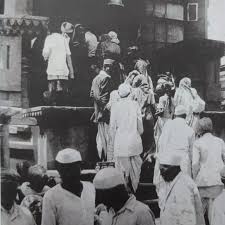
Background of the satyagraha
The problem at Kalaram Temple was exclusion from religious entry on the basis of caste. Dalits were denied the right to enter and worship, not because they lacked devotion, but because caste society treated them as unfit for shared religious space. This denial mattered because it turned religion into a public sign of graded humanity.
The satyagraha was needed because temple exclusion was not only about ritual. It was about status, honor, and who counted as a full member of society. A temple open to some and closed to others by birth announced inequality in one of its most public forms. Ambedkar understood that temple entry, even if not the final goal of emancipation, could expose caste hypocrisy in a sharp and visible way.
By the time of Kalaram, the movement had already shown at Mahad that caste operated through civic exclusion and at Manusmriti Dahan that it also rested on deeper claims of authority. Kalaram extended that struggle into religious space. It asked whether a society that spoke of faith and morality could still deny equal worship to people on the basis of caste.
What happened during the movement
In 1930, Ambedkar organized a major protest at the Kalaram Temple in Nashik. Large numbers of satyagrahis gathered and asserted their right to entry. The action made clear that the right being claimed was not private favor but equal standing in a religious place that caste Hindus treated as open to themselves and closed to others.
The movement continued over time rather than ending in a single day, which is part of why it became so important in the larger history of temple-entry struggles. It was not a symbolic visit followed by silence. It became a sustained public confrontation over whether caste exclusion could still be defended in the name of religion. That continuity mattered because it showed discipline, endurance, and the willingness of oppressed communities to remain in public struggle rather than disappear after one act of refusal.
The continuity of the protest in Nashik also gave the movement a larger public scale. Kalaram was not remembered only because a crowd gathered once at a temple gate. It was remembered because the issue stayed alive, the confrontation did not vanish, and the struggle kept returning the question of caste exclusion to public attention. That persistence helped turn the movement into one of the defining temple-entry struggles in Ambedkarite history.
Resistance from caste Hindus was strong, and the temple did not immediately open. But the satyagraha succeeded in another sense: it made public the fact that temple exclusion was not a side issue. It was one of the ways caste society kept inequality visible and enforceable. By forcing that contradiction into public view, the movement exposed how deeply caste had entered even the language of worship.
Kalaram therefore became more than a dispute about entry at a single temple gate. It showed how religious space could be used to teach social hierarchy and how public protest could break that arrangement open for scrutiny. Even without immediate access, the movement made caste exclusion answer to a larger public moral question.
Role of B. R. Ambedkar
Ambedkar gave the movement both its direction and its political meaning. He did not treat temple entry as the highest goal of the oppressed. Rather, he used it to reveal that those who spoke of morality and religion still accepted exclusion based on birth. That was the deeper contradiction he wanted the public to confront.
His strategy was therefore double. On one side, it asserted equal entry. On the other, it educated oppressed communities about their own condition and about the limits of reform within caste society. He wanted the movement to expose both the injustice of exclusion and the unwillingness of caste society to surrender privilege even in the name of religion.
Ambedkar's role was also important because he kept the movement from being misunderstood as simple devotion seeking permission. He turned temple entry into a public argument about rights, status, and dignity. In doing so, he helped people see that caste did not survive only through insults or customs. It survived through public arrangements that taught some people to think of themselves as higher and others as permanently lesser.
He also gave the movement its larger interpretive force. Without that clarity, Kalaram could have been read only as a request for inclusion within an unequal order. Ambedkar made it something sharper. He used the movement to show both the public cruelty of exclusion and the limits of a society that spoke of reform while preserving caste privilege in practice.
Key outcomes
The Kalaram Temple Satyagraha raised social awareness and widened the reach of organized anti-caste protest. It showed that Ambedkar's movement was willing to challenge discrimination in highly visible spaces and not only in legal or civic settings. That helped make temple exclusion part of a wider public discussion about rights and equality.
It also deepened Ambedkar's own thinking about the limits of temple entry as a solution. The movement helped demonstrate that equal dignity required more than access to places of worship. It required a deeper transformation of the social and moral order, because a society that grants entry without giving up hierarchy still leaves inequality intact.
That deeper lesson is part of why the movement still matters. Kalaram was not only about entering one temple. It became a way of educating oppressed communities about rights, discipline, and the wider structure of caste exclusion. It also helped clarify that public struggle could expose the limits of reform and push people toward larger questions of self-respect and emancipation.
Historical significance
This satyagraha is historically significant because it made religious exclusion part of the national anti-caste argument. It showed that caste hierarchy shaped not just roads and water, but also worship and the public meaning of purity and pollution.
It also stands as one of the major movements through which Ambedkar's leadership made oppressed communities more conscious of rights, public discipline, and collective strength. Kalaram matters because it carried the struggle into a space where caste claimed sacred legitimacy and forced that claim to answer to public reason.
Timeline
| Year | Event |
|---|---|
| 1930 | The temple-entry satyagraha is launched at Kalaram Temple in Nashik under Ambedkar's leadership. |
| 1930 | Large numbers gather to assert the right of Dalits to enter the temple and worship on equal terms. |
| 1930 | Resistance from caste Hindus reveals how strongly temple space is being used to preserve caste hierarchy. |
| 1930s | The movement continues and becomes one of the best-known temple-entry struggles in Ambedkarite history. |
Related movements
Kalaram should be read alongside Parvati Temple Satyagraha and the earlier civic assertion at Mahad. Together these movements show how Ambedkar's struggle moved from civic exclusion into temple-entry and public religious inequality.
Location
Nashik, Maharashtra, at Kalaram Temple.
Questions about the Kalaram Temple Satyagraha
What was the Kalaram Temple Satyagraha?
The Kalaram Temple Satyagraha was a 1930 temple-entry movement led by Dr. B.R. Ambedkar in Nashik to challenge caste-based exclusion from the Kalaram Temple.
Why was the Kalaram Temple Satyagraha important?
The Kalaram Temple Satyagraha was important because it exposed caste exclusion in religious space and turned temple entry into a wider question of equality, status, and public dignity.
Where did the Kalaram Temple Satyagraha take place?
The Kalaram Temple Satyagraha took place at Kalaram Temple in Nashik, Maharashtra.
How is Kalaram connected to Ambedkar's larger movement?
Kalaram is connected to Ambedkar's larger movement because it extended the struggle from civic rights such as water access into religious space, exposing how caste operated through worship, status, and public respect.
Suggest updates
If you notice a missing detail or want to suggest a correction with reliable evidence, please use our Contact Us page so the record can be reviewed carefully.
Conclusion
The Kalaram Temple Satyagraha mattered because it showed that caste exclusion had entered even the language of worship. Ambedkar turned that exclusion into a public question of equality, rights, and self-respect.