22 Vows of Dr. B.R. Ambedkar
Listen to the 22 vows in Hindi for clear understanding and daily reflection.
The Vows
A vow is a discipline, not a slogan.
On 14 October 1956, Dr. B.R. Ambedkar administered the 22 Vows at Deekshabhoomi in Nagpur during the historic mass conversion to Buddhism. The vows explain the meaning of conversion in practical terms. They reject caste-supporting beliefs and ritual authority, affirm Buddhist refuge, and guide the follower toward moral conduct, compassion, equality, and responsibility.
They were given as part of a public act of conversion, not as a private devotional list. That setting matters. The vows helped make the break with caste hierarchy clear, collective, and morally explicit for everyone who entered the new Buddhist path with Babasaheb.
Full text of the 22 Vows
Read the full text of Dr. B.R. Ambedkar's 22 Vows in English, Hindi, and Marathi below.
- I shall have no faith in Brahma, Vishnu and Maheshwara, nor shall I worship them.
- I shall have no faith in Rama and Krishna, nor shall I worship them.
- I shall have no faith in Gauri, Ganapati, or other Hindu deities, nor shall I worship them.
- I do not believe in the incarnation of God.
- I do not believe that the Buddha was an incarnation of Vishnu.
- I shall not perform Shraddha nor give pind-dan.
- I shall not act in ways that violate the principles of the Buddha's Dhamma.
- I shall not allow ceremonies to be performed by Brahmins.
- I shall believe in the equality of human beings.
- I shall endeavor to establish equality.
- I shall follow the Noble Eightfold Path of the Buddha.
- I shall follow the ten paramitas taught by the Buddha.
- I shall have compassion for all living beings and protect them.
- I shall not steal.
- I shall not tell lies.
- I shall not commit sexual misconduct.
- I shall not consume intoxicants.
- I shall live according to wisdom, compassion, and equality.
- I renounce Hinduism, which is harmful to humanity and obstructs equality.
- I firmly believe Buddhism is the true Dhamma.
- I believe I am having a new birth.
- I solemnly declare that I shall conduct my life according to the Buddha's Dhamma.
- मैं ब्रह्मा, विष्णु और महेश में कोई श्रद्धा नहीं रखूंगा और न ही उनकी पूजा करूंगा।
- मैं राम और कृष्ण में कोई श्रद्धा नहीं रखूंगा और न ही उनकी पूजा करूंगा।
- मैं गौरी, गणपति या अन्य हिंदू देवी-देवताओं में कोई श्रद्धा नहीं रखूंगा और न ही उनकी पूजा करूंगा।
- मैं ईश्वर के अवतार में विश्वास नहीं रखूंगा।
- मैं यह नहीं मानूंगा कि बुद्ध विष्णु के अवतार थे।
- मैं श्राद्ध नहीं करूंगा और पिंडदान नहीं दूंगा।
- मैं बुद्ध के धम्म के सिद्धांतों के विरुद्ध कोई आचरण नहीं करूंगा।
- मैं ब्राह्मणों से कोई कर्मकांड नहीं करवाऊंगा।
- मैं मनुष्यों की समानता में विश्वास रखूंगा।
- मैं समानता स्थापित करने का प्रयास करूंगा।
- मैं बुद्ध के आर्य अष्टांगिक मार्ग का पालन करूंगा।
- मैं बुद्ध द्वारा सिखाई गई दस पारमिताओं का पालन करूंगा।
- मैं सभी जीवों के प्रति करुणा रखूंगा और उनकी रक्षा करूंगा।
- मैं चोरी नहीं करूंगा।
- मैं झूठ नहीं बोलूंगा।
- मैं यौन दुराचार नहीं करूंगा।
- मैं नशीले पदार्थों का सेवन नहीं करूंगा।
- मैं प्रज्ञा, करुणा और समानता के अनुसार जीवन जीऊंगा।
- मैं हिंदू धर्म का त्याग करता हूं, जो मानवता के लिए हानिकारक है और समानता में बाधा डालता है।
- मेरा दृढ़ विश्वास है कि बौद्ध धर्म ही सच्चा धम्म है।
- मेरा विश्वास है कि मेरा नया जन्म हो रहा है।
- मैं गंभीरता से घोषणा करता हूं कि मैं अपना जीवन बुद्ध के धम्म के अनुसार चलाऊंगा।
- मी ब्रह्मा, विष्णू आणि महेश यांच्यावर श्रद्धा ठेवणार नाही आणि त्यांची पूजा करणार नाही.
- मी राम आणि कृष्ण यांच्यावर श्रद्धा ठेवणार नाही आणि त्यांची पूजा करणार नाही.
- मी गौरी, गणपती किंवा इतर हिंदू देवी-देवतांवर श्रद्धा ठेवणार नाही आणि त्यांची पूजा करणार नाही.
- मी देवाच्या अवतारावर विश्वास ठेवणार नाही.
- मी बुद्ध हे विष्णूचे अवतार होते असे मानणार नाही.
- मी श्राद्ध करणार नाही आणि पिंडदान देणार नाही.
- मी बुद्धांच्या धम्माच्या तत्त्वांविरुद्ध कोणतेही आचरण करणार नाही.
- मी ब्राह्मणांकडून कोणतेही कर्मकांड करवून घेणार नाही.
- मी सर्व मानवांच्या समानतेवर विश्वास ठेवेन.
- मी समानता प्रस्थापित करण्याचा प्रयत्न करेन.
- मी बुद्धांच्या आर्य अष्टांगिक मार्गाचे पालन करेन.
- मी बुद्धांनी शिकवलेल्या दहा पारमितांचे पालन करेन.
- मी सर्व प्राणिमात्रांबद्दल करुणा बाळगेन आणि त्यांचे रक्षण करेन.
- मी चोरी करणार नाही.
- मी खोटे बोलणार नाही.
- मी लैंगिक दुराचार करणार नाही.
- मी नशा आणणाऱ्या पदार्थांचे सेवन करणार नाही.
- मी प्रज्ञा, करुणा आणि समानता यांनुसार जीवन जगीन.
- मी मानवतेला हानिकारक आणि समानतेला अडथळा आणणाऱ्या हिंदू धर्माचा त्याग करतो.
- बौद्ध धम्म हाच खरा धम्म आहे, यावर माझा दृढ विश्वास आहे.
- माझा नवा जन्म होत आहे, असा माझा विश्वास आहे.
- मी गंभीरपणे जाहीर करतो की मी माझे जीवन बुद्धांच्या धम्मानुसार चालवेन.
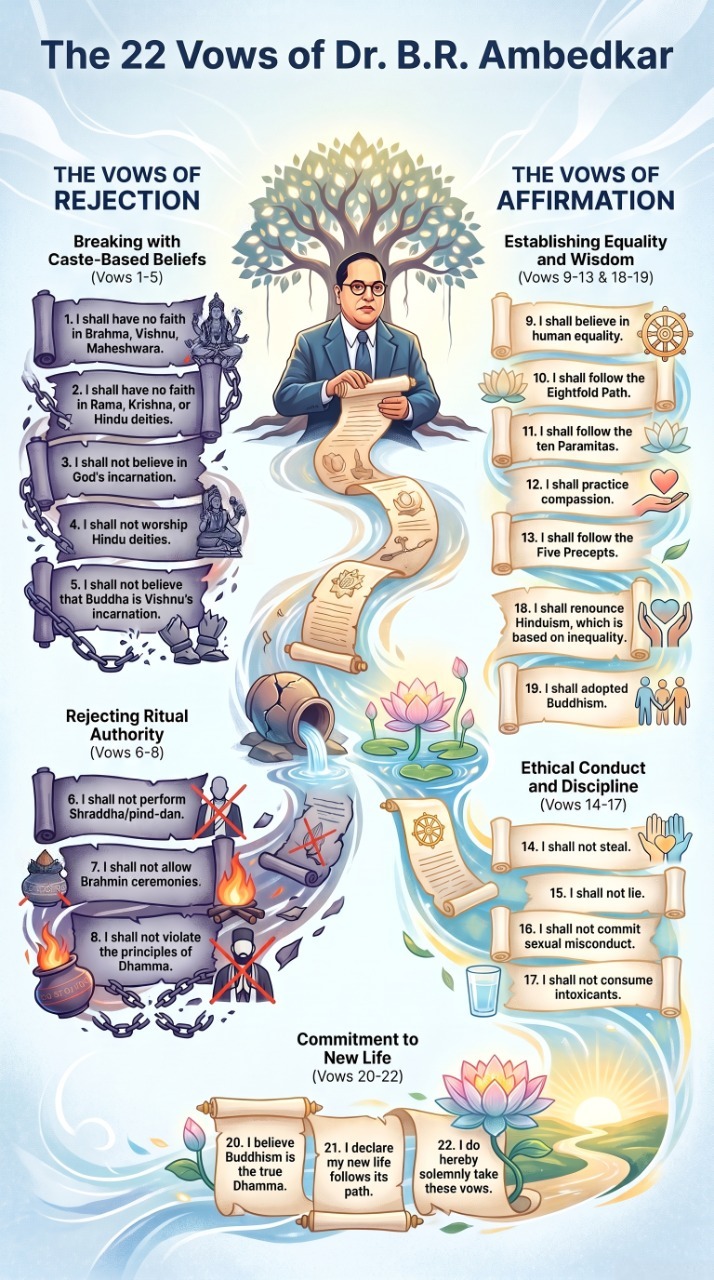
Meaning of the 22 Vows.
The 22 Vows are easier to understand when they are read as a complete path. They do not only say what a person should reject. They also explain what a person should build: equality, self-respect, ethical conduct, and commitment to the Buddha's Dhamma.
Rejection of caste-based beliefs
The early vows reject gods, rituals, and religious authority connected with the caste order. This rejection was not casual. Ambedkar wanted conversion to be a clear break from beliefs that treated people as unequal by birth.
Equality and human dignity
The vows directly affirm equality and the effort to establish equality. This is Samata in action. A follower is not only asked to believe in equality, but to work for it in family, community, and public life.
Ethical living
The vows include moral discipline: not stealing, not lying, avoiding sexual misconduct, avoiding intoxicants, and living with compassion. This makes the vows practical, not only symbolic.
Commitment to Buddhism
The vows affirm confidence in Buddhism and a promise to live according to the Buddha's Dhamma. Conversion becomes a new direction for life, guided by wisdom, compassion, and equality.
Why the 22 Vows matter today.
The 22 Vows still matter because caste discrimination and social humiliation have not disappeared from everyday life. Even when people do not openly defend caste, it can still shape marriage, housing, friendships, schooling, work, and everyday speech. The vows remind us that equality is incomplete if it exists only in law or speeches; it must be practiced in daily conduct.
The vows also protect self-respect. Ambedkar knew that oppressed people were not only denied rights; they were also taught to accept a lower position as normal. The vows refuse that mental slavery. They tell a person not to accept any belief, ritual, or custom that makes one human being lower than another by birth. This is why the vows are important even for people who already believe in equality. They give equality a daily discipline.
They are also important because they encourage clear thinking. Ambedkar did not want people to exchange one form of blind belief for another. He wanted people to study, question, understand, and act responsibly. The vows ask a person to leave practices that support hierarchy and to follow a path based on Dhamma, morality, compassion, and equality.
In daily life, the vows guide simple choices: do not measure people by caste, do not participate in humiliating customs, and do not stay silent when discrimination is treated as tradition. Speak truthfully, avoid harm, keep learning, and treat people from every background with dignity. In this way, the vows remain a practical guide for freedom, not only a memory of 1956.
How to follow the 22 Vows daily.
A person does not follow the 22 Vows only by reading them on special days. They become meaningful when they shape ordinary decisions. Respect equality. Avoid blind faith. Practice ethical behavior. Question injustice when it appears in family, society, school, work, or public life.
For a simple routine, read how to practice Ambedkarite Buddhism daily.
Continue learning.
To understand the wider meaning of the vows, read Ambedkarite Buddhism. To build a daily practice with chanting and reflection, use Buddha Vandana. For practical steps, read how to practice Ambedkarite Buddhism. To understand the reason behind conversion, read why Ambedkar chose Buddhism.
Common questions.
What are the 22 Vows of Ambedkar?
The 22 Vows are commitments given by Dr. B.R. Ambedkar at Deekshabhoomi, Nagpur, on 14 October 1956. They explain the ethical and social meaning of conversion to Buddhism.
Why did Ambedkar create these vows?
Ambedkar created the vows so conversion would be clear and practical. The vows reject caste-based beliefs and guide people toward Buddhism, equality, moral conduct, and self-respect.
Are the 22 Vows compulsory?
For Ambedkarite Buddhists, the vows are central to the meaning of conversion. They are treated as serious commitments, not as casual statements.
Can anyone follow the 22 Vows?
Anyone who sincerely accepts their ethical direction can study and follow them. The vows ask for equality, rational thinking, compassion, and Buddhist conduct.
Where were the 22 Vows given?
They were given at Deekshabhoomi in Nagpur on 14 October 1956, during the historic conversion led by Dr. B.R. Ambedkar.
Why do some vows reject Hindu gods and rituals?
Ambedkar wanted conversion to be a clear break from religious beliefs and practices that supported caste hierarchy. The rejection was connected to human equality and self-respect.
How are the 22 Vows connected with Navayana Buddhism?
The vows express Ambedkar's Navayana understanding of Buddhism. Their core message is to leave caste-based thinking and live by the Buddha's Dhamma with equality, reason, compassion, and moral responsibility.
What should a beginner do after reading the 22 Vows?
A beginner can choose one practical step: stop using caste-based language, read about Ambedkar's conversion, practice honest speech, or begin a simple daily Buddhist routine.
Are the 22 Vows still relevant today?
Yes. They remain relevant wherever caste discrimination, blind faith, social humiliation, or unequal treatment continues. They give a clear direction for equality and rational conduct.
Freedom with responsibility.
The 22 Vows are important because they join freedom with responsibility. They call for freedom from caste, superstition, and imposed inferiority. They also call for a life of equality, rationality, compassion, and ethical conduct. Their message is strong, but it does not need to be shouted. It becomes powerful when people live it steadily.